
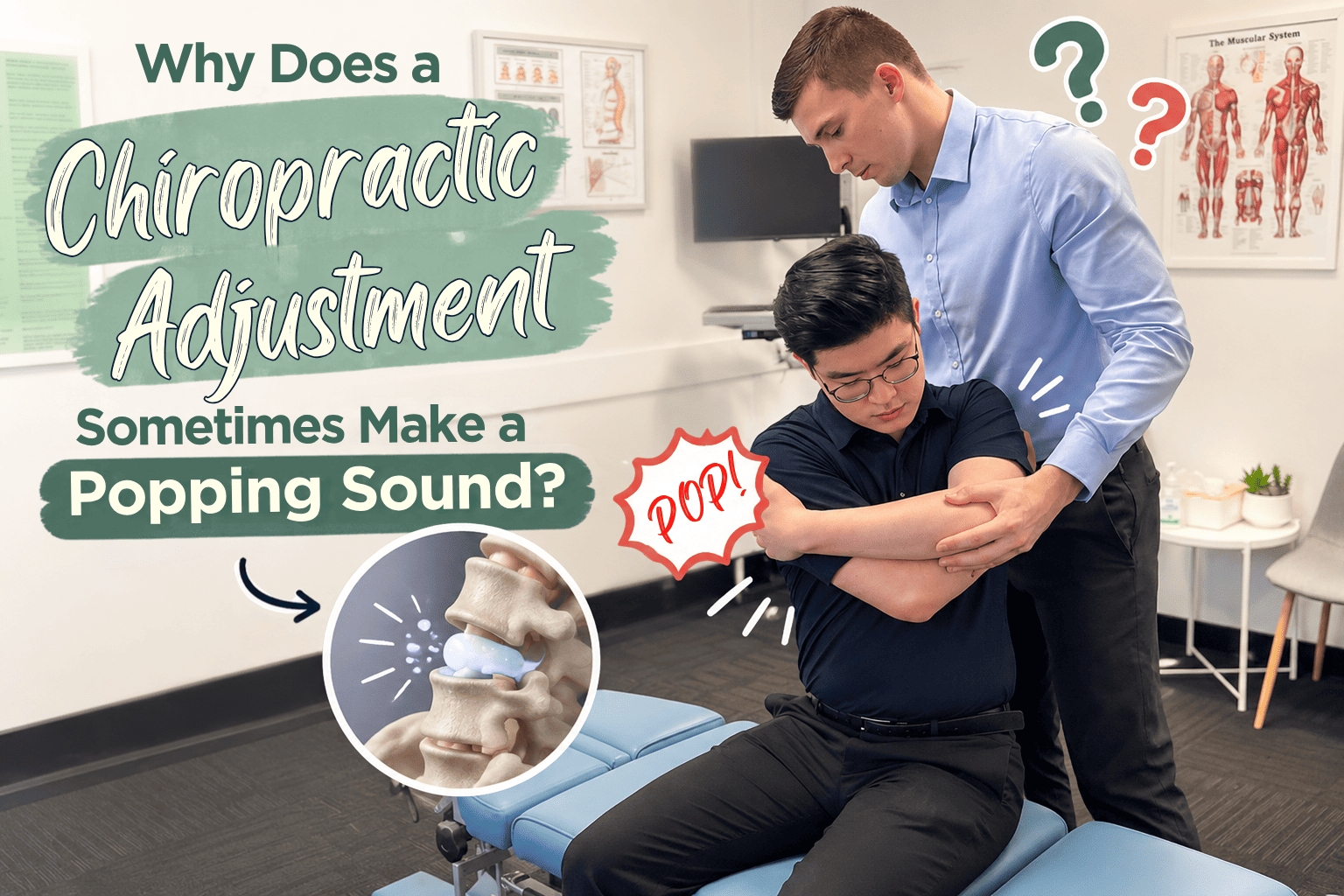
Why Does a Chiropractic Adjustment Sometimes Make a Popping Sound?

If you have ever had a chiropractic adjustment, you may have heard a small pop, click or cracking sound during the movement.
For some people, it is completely unexpected.
For others, it can be the first thing they notice during an appointment.
So what actually causes the sound?
In many cases, the sound comes from a rapid change in pressure within a joint, rather than bones cracking or being forced back into place.
Importantly, the sound itself is not a measure of whether an adjustment was successful.
An adjustment can be performed without an audible pop, and not every person will experience the same sensation or sound.
Joints contain fluid that helps them move smoothly.
When a joint is moved or gently manipulated, the pressure within the joint can change quickly.
This can create a phenomenon known as cavitation, which can produce the familiar popping or cracking sound.
Think about cracking your knuckles.
The sound does not mean that the bones are breaking.
A similar principle can explain some of the sounds associated with joint manipulation.
The word “cracking” can make the process sound much more dramatic than it is.
In a typical joint pop, the sound is not caused by bones breaking against each other.
It is also not necessarily a sign that something has been “put back into place”.
The exact source of an audible joint sound can vary depending on the movement and the joint involved.
No.
This is one of the most common misconceptions.
A loud pop does not mean an adjustment was more effective.
Likewise, a quiet adjustment is not automatically less effective.
The goal of chiropractic care should not be to produce as many popping sounds as possible.
Instead, treatment should be based on your symptoms, history, examination findings and individual needs.
The sound is a possible by-product of some joint movements, not the goal of treatment.
You may have an adjustment one day that produces a pop and another appointment where you hear nothing.
That can be completely normal.
Whether an audible sound occurs can depend on:
Some chiropractic techniques are also designed to use slower, gentler movements or other approaches that may not produce an audible sound.
This is why you should not judge the treatment by whether you hear a crack.
An adjustment should be explained to you beforehand, including what you may feel during the technique.
Some people describe a brief sense of pressure or movement.
Others notice very little.
The experience depends on the technique used and the individual.
If a movement is painful or something does not feel right, tell your chiropractor.
Communication matters during treatment.
You should feel comfortable asking what is being done, why it is being recommended and what you can expect to feel.
Some people enjoy the feeling of cracking their joints because it can provide a temporary sense of release.
But wanting to hear a pop is different from needing repeated treatment.
If you find yourself repeatedly twisting or forcing your neck or back simply to make it crack, it is worth being cautious.
Forcefully manipulating your own neck, particularly into end-range positions, is not the same as receiving an appropriately assessed clinical technique.
If you regularly feel the need to crack an area because it feels uncomfortable, it may be more useful to understand why the discomfort keeps returning.
Chiropractic care can be appropriate for some people with musculoskeletal problems, but no healthcare treatment is completely risk-free.
The suitability of an adjustment depends on factors such as your health history, symptoms, medications, previous injuries and examination findings.
A qualified practitioner should consider whether a particular technique is appropriate for you.
Some techniques may also be modified or avoided depending on your circumstances.
This is one reason an individual assessment is important rather than assuming the same treatment is suitable for everyone.
Before treatment, let your chiropractor know about relevant changes in your health or symptoms.
This can include:
This information helps your practitioner determine whether a particular approach is appropriate.
A rapid change in pressure within a joint can produce an audible sound, often referred to as cavitation. The sound is not caused by bones breaking.
No. The volume of a popping sound does not indicate whether an adjustment was effective. An adjustment can be appropriate without producing any audible sound.
Yes. Not every adjustment produces a popping sound. The technique used, the joint involved and individual factors can all affect whether an audible sound occurs.
The idea that an audible pop means a bone has been put back into place is an oversimplification. Chiropractic treatment should be based on an individual’s symptoms, history and examination findings.
People can experience different sensations during and after treatment. Some may feel brief pressure or movement, while others may experience temporary soreness. Tell your chiropractor if a technique causes significant pain or feels uncomfortable.
Chiropractic care may be appropriate for some musculoskeletal conditions, but treatment is not risk-free and suitability depends on the individual. A practitioner should consider your history, symptoms and examination findings before recommending a technique.
Curious about whether chiropractic care is appropriate for your symptoms? An individual assessment can help determine which treatment options may be suitable based on your history, symptoms and examination findings. Wellbeing Chiropractic has clinics across Melbourne, Sydney and Brisbane. Book an appointment to discuss your concerns and ask any questions you have before treatment.
Author
I’m Dr William Laidlaw, an AHPRA registered chiropractor across our Carlton and Werribee clinics. Swimming was my first education, years of high-level training, Olympic trials, state titles and overseas blocks, which taught me what pushing a body hard costs and what proper recovery asks. Chiropractic runs in my family, my uncle’s way of practising shaped mine, and RMIT’s double degree made it official, with regular technique and theory seminars keeping it current. Headaches, migraines, vertigo and stubborn neck or shoulder pain fill most of my week, and none of them get treated before I understand what is producing them.
Select a location to book your $49 May assessment
Select a location to book your $49 May assessment
Select a location to book your $49 May assessment
Select your Victoria clinic to book your $49 new patient visit.
$49 New Patient Assessment ● First Adjustment Included*
*Adjustment included when your chiropractor confirms care is clinically appropriate for you. If chiropractic isn’t the right fit, we’ll tell you that too.
Select your New South Wales clinic to book your $49 new patient visit.
$49 New Patient Assessment ● First Adjustment Included*
*Adjustment included when your chiropractor confirms care is clinically appropriate for you. If chiropractic isn’t the right fit, we’ll tell you that too.
Select your Queensland clinic to book your $49 new patient visit.
$49 New Patient Assessment ● First Adjustment Included*
*Adjustment included when your chiropractor confirms care is clinically appropriate for you. If chiropractic isn’t the right fit, we’ll tell you that too.