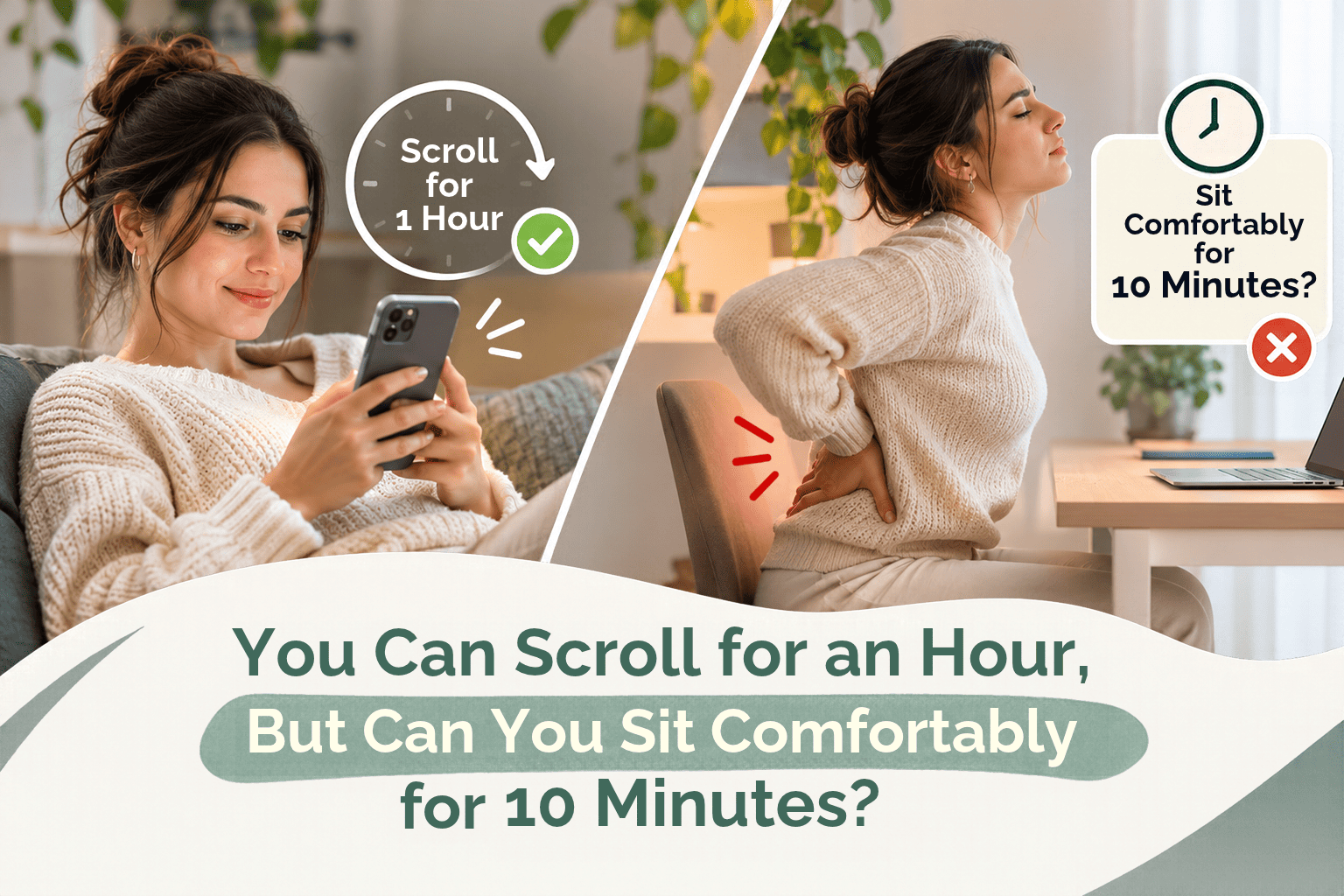
You Can Scroll for an Hour, But Can You Sit Comfortably for 10 Minutes?
You settle onto the couch, open your phone and start scrolling.
Ten minutes become twenty. Twenty become an hour.
You barely notice how long you’ve been sitting.
But try sitting at a desk without your phone, watching television without shifting position or waiting in a chair for an appointment. Suddenly, your lower back feels uncomfortable, your shoulders become tense and you find yourself constantly adjusting.
Why does sitting feel so different when you’re not distracted?
The answer may involve more than your posture. Your movement habits, physical activity, sitting position, muscle endurance and even your attention to discomfort can influence how comfortable you feel when sitting.
The interesting part is that scrolling for an hour does not necessarily mean your body is comfortable. It may simply mean you are less aware of how long you have been sitting or the position you are holding.
Your phone can distract you from how your body feels:
When you’re scrolling, your attention is focused on the screen.
You’re reading messages, watching videos, responding to notifications and moving between different apps.
Your brain is occupied, which can make you less aware of minor discomfort developing in your body.
Compare that with sitting in a waiting room or attending a meeting where you have very little to focus on.
You may become much more aware of stiffness, pressure or discomfort.
This does not mean the pain is imaginary. Attention can influence how noticeable physical sensations become.
It is one reason two sitting situations that look similar can feel quite different.
Why sitting still can become uncomfortable:
Your body is designed to move throughout the day.
Even when sitting, your muscles help support your trunk, control your head position and maintain balance.
Problems can arise when you remain in a relatively fixed position for an extended period, particularly if that position is uncomfortable for you.
Here are some factors that may contribute.
1. Your muscles are holding the same position
When you sit, muscles around your spine, hips and trunk help support your body.
If you remain in one position for a long time, some muscles may experience sustained loading.
You might notice:
tension across your shoulders
stiffness around your hips
discomfort when standing up
a constant urge to change position
This does not necessarily indicate muscle damage.
It may simply mean your body would benefit from a change in position and movement.
2. Your phone encourages a different sitting position
Think about how you usually hold your phone.
Your head may move forwards, your shoulders may round and your upper back may become more flexed as you look down at the screen.
You might also sit with one leg tucked underneath you, lean against one armrest or slide down into the couch.
These positions are not automatically harmful.
The issue is that you may remain in them for longer than you realise.
Over time, certain positions can become uncomfortable, particularly if you already experience neck or back symptoms.
3. You may be getting less movement throughout the day
Scrolling is often part of a larger pattern of inactivity.
You might spend the morning at a desk, sit during your commute, relax with your phone at lunchtime and then spend the evening watching television.
Although you may change between several sitting positions, your overall movement throughout the day can still be limited.
Your body benefits from regular movement, not just occasional exercise sessions.
Short walks, standing breaks and everyday activities all contribute to movement variety.
Why does your back hurt more when you sit without moving?
One common complaint is that the lower back feels fine while walking but becomes uncomfortable after sitting for a short period.
There can be several explanations.
Sitting changes the position of your hips and lower back. Depending on the chair and your individual movement preferences, certain sitting positions may increase symptoms.
For some people, remaining seated for extended periods may aggravate existing lower back problems.
Others may feel more comfortable sitting than standing.
There is no universal sitting position that works for everybody.
If you regularly experience back pain when sitting, the important thing is to understand your individual symptom pattern rather than assuming poor posture is always responsible.
The difference between being comfortable and being distracted:
Here’s something worth considering.
When you’re scrolling, are you actually comfortable, or are you simply not paying attention?
You might have your neck bent forwards, your shoulders rounded and your hips in an awkward position without noticing.
Then you put your phone down and suddenly become aware of your stiffness.
This is a useful reminder that the absence of noticeable pain does not necessarily mean your body is in an ideal position.
It is also why trying to maintain one perfect posture throughout the day is not the answer.
Your body generally benefits from changing positions rather than holding any single position indefinitely.
When is sitting discomfort worth getting checked?
Occasional stiffness after a long day is not necessarily a concern.
However, persistent discomfort should not simply be accepted as part of modern life.
Consider arranging an assessment if:
back or neck pain regularly develops when sitting
you struggle to remain comfortable during everyday activities
discomfort is becoming more frequent
pain travels into your arms or legs
you experience ongoing tingling or numbness
symptoms interfere with sleep, work or exercise
you are regularly changing your routine to avoid discomfort
New or progressive weakness, loss of bladder or bowel control, or numbness around the groin or inner thighs alongside back pain requires urgent medical assessment.
Can a chiropractor help with discomfort when sitting?
Depending on the cause of your symptoms, chiropractic care may be one option for assessing certain musculoskeletal concerns.
An assessment may consider your spinal and joint movement, relevant muscle function, health history, work habits and the activities that make your symptoms better or worse.
For example, someone who experiences lower back discomfort after sitting at a desk may benefit from an assessment that considers more than just their sitting posture.
Recommendations should be based on individual findings and may include appropriate treatment, movement advice or exercises.
If your symptoms suggest another medical condition or require further investigation, referral to an appropriate healthcare professional may be recommended.
FAQ
Why does my back hurt after sitting for only 10 minutes?
There are several possible explanations, including prolonged positioning, existing lower back sensitivity, reduced movement tolerance or an underlying musculoskeletal condition. The cause varies between individuals and may require an assessment.
Why can I sit on the couch for hours but not at my desk?
Your couch and desk may place your body in different positions. Your attention and activity may also differ. The type of chair, hip position, support and how frequently you change position can all influence comfort.
Does looking down at my phone cause neck pain?
Prolonged downward positioning may contribute to neck and shoulder discomfort in some people, particularly when combined with sustained muscle activity and limited movement. Regular position changes may help.
Is sitting bad for your spine?
Sitting is not inherently bad for your spine. However, spending long periods in one position without movement may contribute to discomfort for some people. Regular activity and movement variety are generally useful.
How often should I get up from sitting?
There is no single interval that suits everyone. A practical approach is to change position regularly and avoid remaining seated for unnecessarily long periods. Your needs may differ depending on your symptoms and daily routine.
Can exercise improve sitting tolerance?
Appropriate exercise can help develop strength, endurance and general physical capacity. However, if sitting causes persistent pain, it is worth understanding the underlying contributors rather than assuming exercise alone will resolve it.
If you find sitting uncomfortable, even for short periods, it may be worth understanding what is contributing to the problem. Wellbeing Chiropractic with clinics across Melbourne, Sydney and Brisbane. Book an appointment to discuss your symptoms, movement and daily habits and explore appropriate care options based on your individual circumstances.

Author
Dr. Martin Sexton
I’m Dr Martin Sexton, chiropractor at our Point Cook clinic. RMIT’s chiropractic double degree trained me, the ACA keeps me current, and recognition has followed the work: Wellbeing’s Growth award in 2023, its Excellence award in 2024, and Bupa preferred provider status at the clinic. Headaches, migraines and sciatica are the caseload I have deliberately built, three conditions where thorough assessment pays its way, and my technique range runs from Diversified adjusting through Activator and SOT block work to spinal decompression. Collaboration is the method: you bring the goal, marathon, recovery or keeping up with the kids, and we build toward it together.