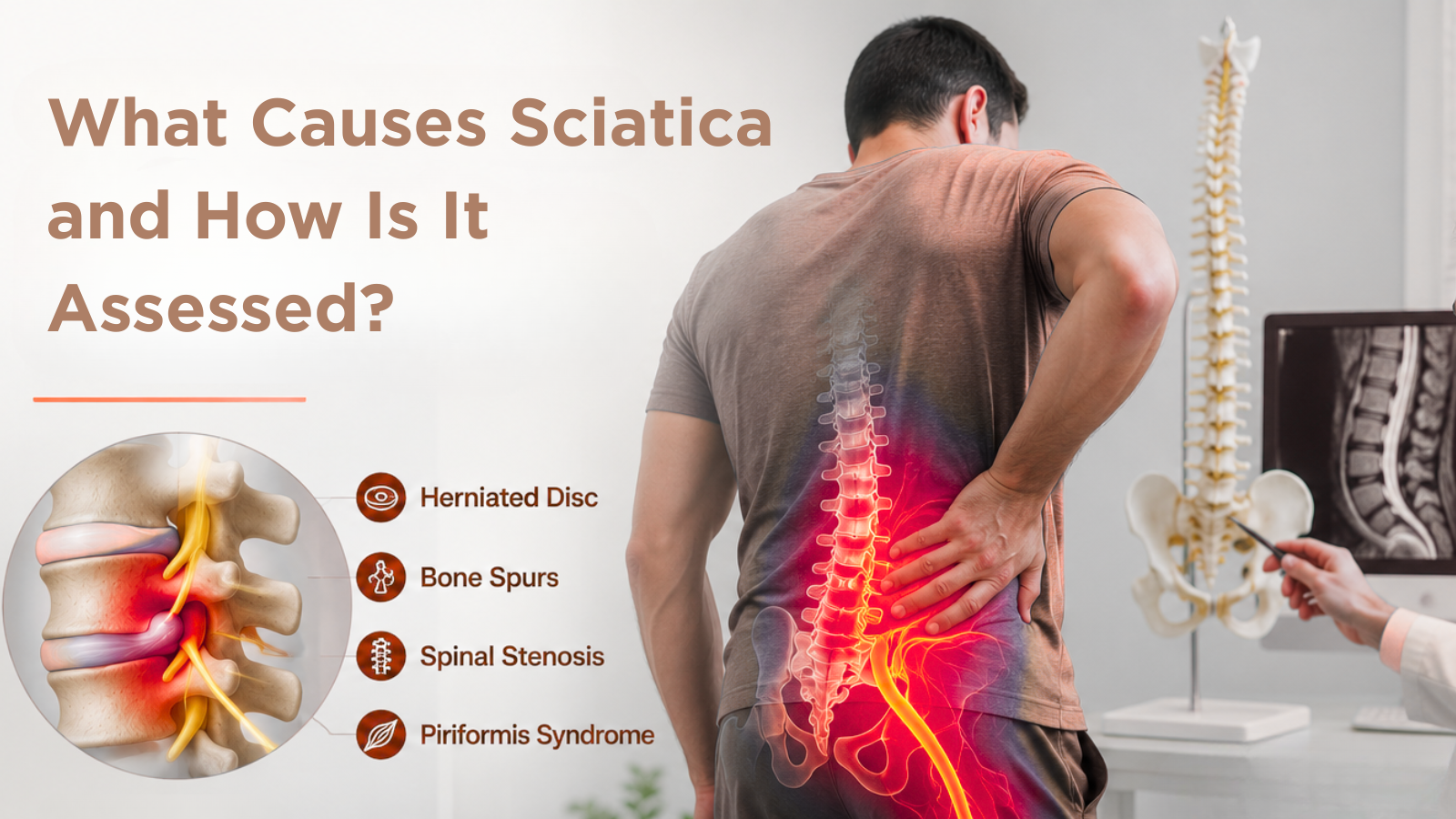
What Causes Sciatica and How Is It Assessed?

Sciatica is a term many people hear when experiencing pain that travels from the lower back into the buttock, leg or foot. While it is often associated with lower back problems, sciatica is not actually a diagnosis itself. Rather, it describes a collection of symptoms that occur when the sciatic nerve becomes irritated or affected.
Sciatica can range from mild discomfort to more significant pain that interferes with daily activities, work and exercise. Understanding what causes sciatica and how it is assessed can help people better understand their symptoms and the importance of seeking an accurate diagnosis.
Sciatica refers to pain, tingling, numbness or other symptoms that travel along the path of the sciatic nerve.
The sciatic nerve is the largest nerve in the body. It originates in the lower spine and travels through the buttocks and down each leg.
When the nerve becomes irritated, compressed or inflamed, symptoms may develop anywhere along its pathway.
Common symptoms of sciatica include:
Symptoms can vary significantly between individuals. Some people experience mild discomfort, while others may find symptoms more limiting.
There are several potential causes of sciatic nerve irritation.
One of the more common causes of sciatica involves changes affecting the spinal discs.
The discs sit between the vertebrae and act as shock absorbers. In some situations, disc changes may place pressure on nearby nerve structures, potentially contributing to sciatic symptoms.
Not all disc changes cause pain, and findings on imaging do not always directly correlate with symptoms. This is why a comprehensive assessment is important.
Changes affecting joints in the lower spine may sometimes contribute to narrowing around nerve pathways, which can irritate nearby nerves.
These changes are often influenced by factors such as age, physical demands and overall spinal health.
Certain muscles in the hip and buttock region can occasionally contribute to symptoms that resemble sciatica.
For example, tightness or irritation involving deep hip muscles may affect nearby nerve structures and lead to leg pain or tingling sensations.
Jobs or activities involving frequent lifting, bending, twisting or prolonged sitting may increase stress on the lower back and surrounding structures.
While these activities do not automatically cause sciatica, they may contribute to symptoms in some individuals.
A history of lower back injury may sometimes increase the likelihood of recurring sciatic symptoms, particularly if mobility, strength or movement patterns have been affected.
Yes.
Some people experience prominent leg symptoms with very little lower back discomfort.
Because the sciatic nerve travels down the leg, irritation can sometimes produce symptoms primarily in the buttock, thigh, calf or foot.
This can occasionally lead people to assume the problem is located in the leg itself when the source may involve structures in the lower back or pelvis.
A thorough assessment aims to identify whether symptoms are likely related to sciatic nerve irritation and what factors may be contributing.
A practitioner will typically ask questions about:
The pattern of symptoms often provides important clues.
Chiropractic care may form part of a broader management approach for some people experiencing lower back and sciatic symptoms.
After an appropriate assessment, care may include:
The aim is often to support movement, mobility and physical function while addressing factors that may be contributing to symptoms.
Recommendations are based on the individual’s history, examination findings and goals.
It may be helpful to seek assessment if you experience:
Prompt assessment may help identify contributing factors and support appropriate management.
Sciatica is commonly associated with irritation or compression of the sciatic nerve, often involving structures in the lower back such as spinal discs or joints.
Some episodes of sciatica may improve over time, while others may require professional assessment and management depending on the severity and contributing factors.
Common symptoms include pain, tingling, numbness or burning sensations travelling from the lower back into the buttock and leg. A professional assessment can help confirm whether symptoms are consistent with sciatica.
No. While disc-related issues can contribute to sciatica, other factors such as joint changes, muscle irritation and nerve sensitivity may also be involved.
After an appropriate assessment, chiropractic care may help support mobility, movement quality and musculoskeletal function for some individuals experiencing sciatic symptoms.
Experiencing pain, tingling or discomfort travelling down your leg? Book an appointment online with Wellbeing Chiropractic clinics across Melbourne, Sydney and Brisbane for a thorough assessment and personalised care plan tailored to your needs.Author
Dr Josh Tyquin is an experienced & sought-after Chiropractor who is the principal Chiropractor at Wellbeing Chiropractic Hawthorn. He was first introduced to Chiropractic during childhood after suffering a sporting injury. It was after this positive personal experience Josh decided to pursue a career in Chiropractic.
Select a location to book your $49 May assessment
Select a location to book your $49 May assessment
Select a location to book your $49 May assessment
Select your Victoria clinic to book your $49 new patient visit.
$49 New Patient Assessment ● First Adjustment Included*
*Adjustment included when your chiropractor confirms care is clinically appropriate for you. If chiropractic isn’t the right fit, we’ll tell you that too.
Select your New South Wales clinic to book your $49 new patient visit.
$49 New Patient Assessment ● First Adjustment Included*
*Adjustment included when your chiropractor confirms care is clinically appropriate for you. If chiropractic isn’t the right fit, we’ll tell you that too.
Select your Queensland clinic to book your $49 new patient visit.
$49 New Patient Assessment ● First Adjustment Included*
*Adjustment included when your chiropractor confirms care is clinically appropriate for you. If chiropractic isn’t the right fit, we’ll tell you that too.