
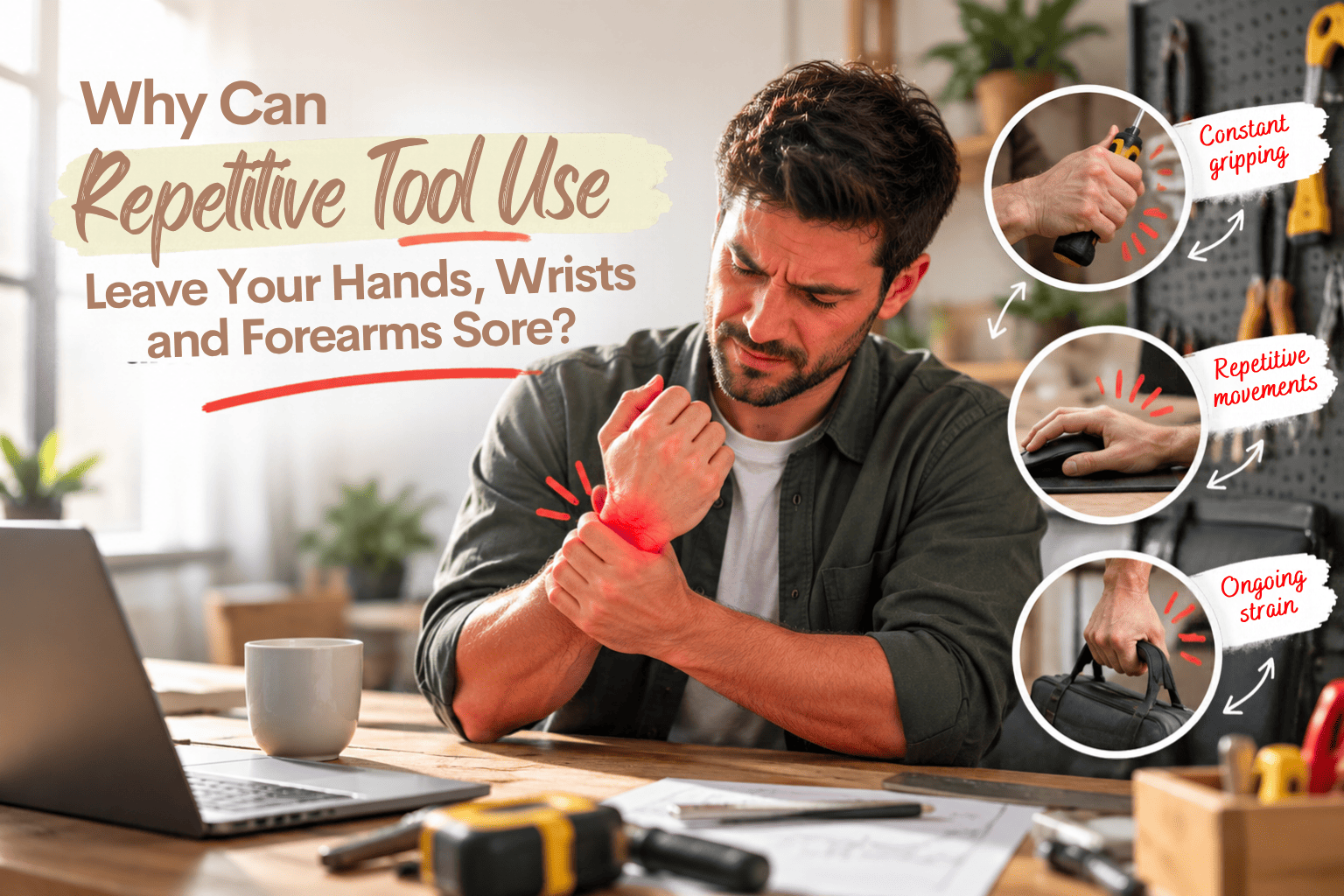
Why Can Repetitive Tool Use Leave Your Hands, Wrists and Forearms Sore?
By the end of a long shift, your hands might feel stiff, your wrists may ache and your forearms might feel as though they have been working overtime.
Perhaps you have spent the day drilling, sanding, tightening screws, using a wrench or operating vibrating equipment. Each individual task seemed manageable, but after hours of repeating the same movements, your hands and arms are telling a different story.
If this sounds familiar, repetitive tool use may be contributing to your hand, wrist or forearm pain.
Your hands are designed to perform precise movements and handle loads, but repeated gripping, twisting and wrist movements can place considerable demands on the muscles, tendons and other structures in your arms.
The issue is not necessarily one particularly heavy movement. It can be the combination of repetition, grip force, tool design, working position and limited recovery time across an entire shift.
Understanding these factors can help you recognise what may be contributing to your discomfort and when it is worth getting checked.
Why does repetitive tool use make your hands and wrists sore?
Using tools requires more than moving your fingers.
Your fingers grip the handle, your wrist helps position the tool, and muscles throughout your forearm generate and control force. Your shoulder and upper body may also contribute, particularly when working overhead or handling heavier equipment.
When the same movement is repeated for hours, the tissues involved may have limited opportunity to recover between tasks.
Several factors can influence how your body responds.
1. Your grip stays switched on
Think about using a screwdriver, pliers or a power drill.
Your fingers need to maintain a secure grip while your forearm muscles help control the movement. Depending on the task, you may need to squeeze firmly, stabilise the tool or resist twisting forces.
Repeat that action hundreds of times, and the workload adds up.
A tool that requires a particularly strong grip can increase the demand on your hand and forearm muscles. If the handle is too large, too small or uncomfortable to hold, gripping may become more demanding than necessary.
This can contribute to muscle fatigue and soreness, particularly during long periods of uninterrupted work.
2. Your wrist repeatedly moves into the same positions
Not every job allows you to keep your wrist in a comfortable, neutral position.
You might need to bend your wrist backwards, angle it sideways or rotate your forearm to reach a fastener in a confined space.
These positions are sometimes unavoidable. However, combining them with forceful gripping and repeated movements can increase the demands placed on the wrist and surrounding tissues.
For example, tightening fittings underneath a sink may involve a very different wrist position from using a drill at waist height.
The tool matters, but so does the space in which you are using it.
3. Your forearm muscles have to control every movement
Your forearms contain muscles and tendons involved in gripping, wrist movement and finger control.
When you use tools repeatedly, these structures work to produce force and control the movement of the equipment.
If the workload is greater than your tissues can comfortably tolerate, you may notice aching, tenderness or fatigue around the forearm.
Pain near the outside or inside of the elbow can sometimes involve the tendons responsible for wrist and finger movements. However, forearm pain has several possible causes, so the location alone cannot confirm what is responsible.
Why does the pain appear towards the end of the day?
You may feel fine when you start work, then notice increasing discomfort as the hours pass.
This does not necessarily mean you have injured yourself during one particular movement.
Your symptoms may reflect the combined effect of repeated gripping, forceful movements, awkward wrist positions and the amount of time spent using your hands without sufficient recovery.
Consider a typical workday:
You start with a few hours of drilling or fastening.
You move on to cutting, sanding or handling materials.
You spend the afternoon using hand tools in a confined space.
You finish by loading equipment and packing up.
Each task places slightly different demands on your hands and arms, but there may be considerable overlap in the muscles and tendons being used.
By the end of the shift, those tissues may feel tired or uncomfortable.
The key point is that pain developing gradually throughout the workday can reflect accumulated physical demand, not necessarily one sudden injury.
However, pain that persists between shifts or continues to worsen deserves more attention than occasional, short-lived fatigue.
Could your tool grip or equipment be contributing?
Sometimes, small details about the tool can make a meaningful difference to how demanding a task feels.
Consider the following factors.
Handle size: A handle that does not suit your hand may require more effort to maintain a secure grip.
Tool weight: Heavier equipment can increase the force required to hold and control it, especially when used overhead or away from your body.
Maintenance: Blunt cutting edges, poorly maintained tools or equipment that does not operate properly may require additional force.
Access to the work area: Tight spaces can make it difficult to position your wrist comfortably or use your strongest grip.
Vibration: Certain tools create additional exposure that needs to be managed through appropriate equipment and workplace controls.
Where practical, use well-maintained tools suited to the task, and consider ergonomic equipment designed to reduce unnecessary grip force or awkward positioning.
These adjustments will not resolve every cause of pain, but they may help reduce avoidable demands.
Is it repetitive strain injury?
You may have heard the term repetitive strain injury, often shortened to RSI.
RSI is commonly used as a broad term for pain or other symptoms associated with repeated movements, sustained positions or excessive physical demands. It is not a specific diagnosis that identifies exactly which structure is affected.
Repeated tool use can contribute to several different conditions, including:
Tendon-related pain: Irritation or problems involving tendons around the wrist, hand or elbow.
Nerve compression: Conditions such as carpal tunnel syndrome, which can cause tingling, numbness or weakness in parts of the hand.
Muscle fatigue or strain: Discomfort associated with demanding or repeated muscular activity.
Other wrist or hand conditions: Joint problems, previous injuries and other conditions can also produce similar symptoms.
These conditions can overlap in how they feel.
For example, aching around the wrist does not automatically mean you have a repetitive strain injury, and tingling fingers should not automatically be attributed to tight forearm muscles.
If symptoms persist, an appropriate assessment can help determine what may be contributing.
Should you stretch your wrists and forearms?
Gentle movement may feel comfortable after repetitive work, but stretching is not a universal solution for hand and wrist pain.
The right approach depends on the cause of your symptoms.
If a gentle movement feels comfortable, it may be reasonable to include it in your routine. However, avoid forcing a stretch that increases pain, tingling or numbness.
Persistent symptoms may require more than stretching, particularly if they involve a tendon problem, nerve compression or another underlying condition.
An individual assessment can help determine which movements or exercises are appropriate for your situation.
Can a chiropractor help with hand, wrist or forearm pain?
Depending on the cause of your symptoms, chiropractic care may be one option for assessing and managing some musculoskeletal problems affecting the wrist, forearm, elbow or surrounding areas.
An assessment may consider your symptoms, work activities, grip and movement, previous injuries and the tasks that reproduce your discomfort.
However, not all hand and wrist problems are primarily musculoskeletal. Symptoms involving nerve compression, significant injury or circulation changes may require medical assessment or another form of care.
Treatment recommendations should be based on your individual history and examination findings, rather than assuming that all pain from repetitive tool use has the same cause.
FAQ
Why do my forearms hurt after using tools all day?
Repeated gripping, wrist movements and forceful tool use can fatigue the forearm muscles and place demands on the tendons. The cause can vary, particularly if pain persists or occurs alongside numbness or weakness.
Can using a drill cause wrist pain?
It can contribute to wrist discomfort, depending on the drill’s weight, vibration, grip requirements, working position and duration of use. Persistent pain should be assessed rather than automatically attributed to the tool.
What is the difference between muscle soreness and repetitive strain injury?
Muscle soreness may settle with recovery after demanding work. Repetitive strain injury is a broad term for symptoms associated with repeated or sustained physical demands. Ongoing pain, tingling, numbness or weakness may indicate a condition that needs specific assessment.
Should I keep working if my wrist hurts?
That depends on the severity and cause of the pain. Continuing the same aggravating activity may worsen some conditions. Follow workplace safety procedures, consider appropriate task modifications and seek advice if symptoms persist or affect your grip or function.
Can repetitive tool use cause numb fingers?
Yes, certain types of tool use, particularly where vibration or sustained pressure is involved, can contribute to nerve-related symptoms. Numbness can also have other causes, so persistent or worsening symptoms should be assessed.
If repetitive tool use is leaving your hands, wrists or forearms sore, it may be worth finding out what is contributing to your symptoms. Wellbeing Chiropractic has clinics across Melbourne, Sydney and Brisbane. Book an appointment to help clarify your options based on your history, symptoms and examination findings.

Author
Dr Josh Tyquin
Dr Josh Tyquin is an experienced & sought-after Chiropractor who is the principal Chiropractor at Wellbeing Chiropractic Hawthorn. He was first introduced to Chiropractic during childhood after suffering a sporting injury. It was after this positive personal experience Josh decided to pursue a career in Chiropractic.