
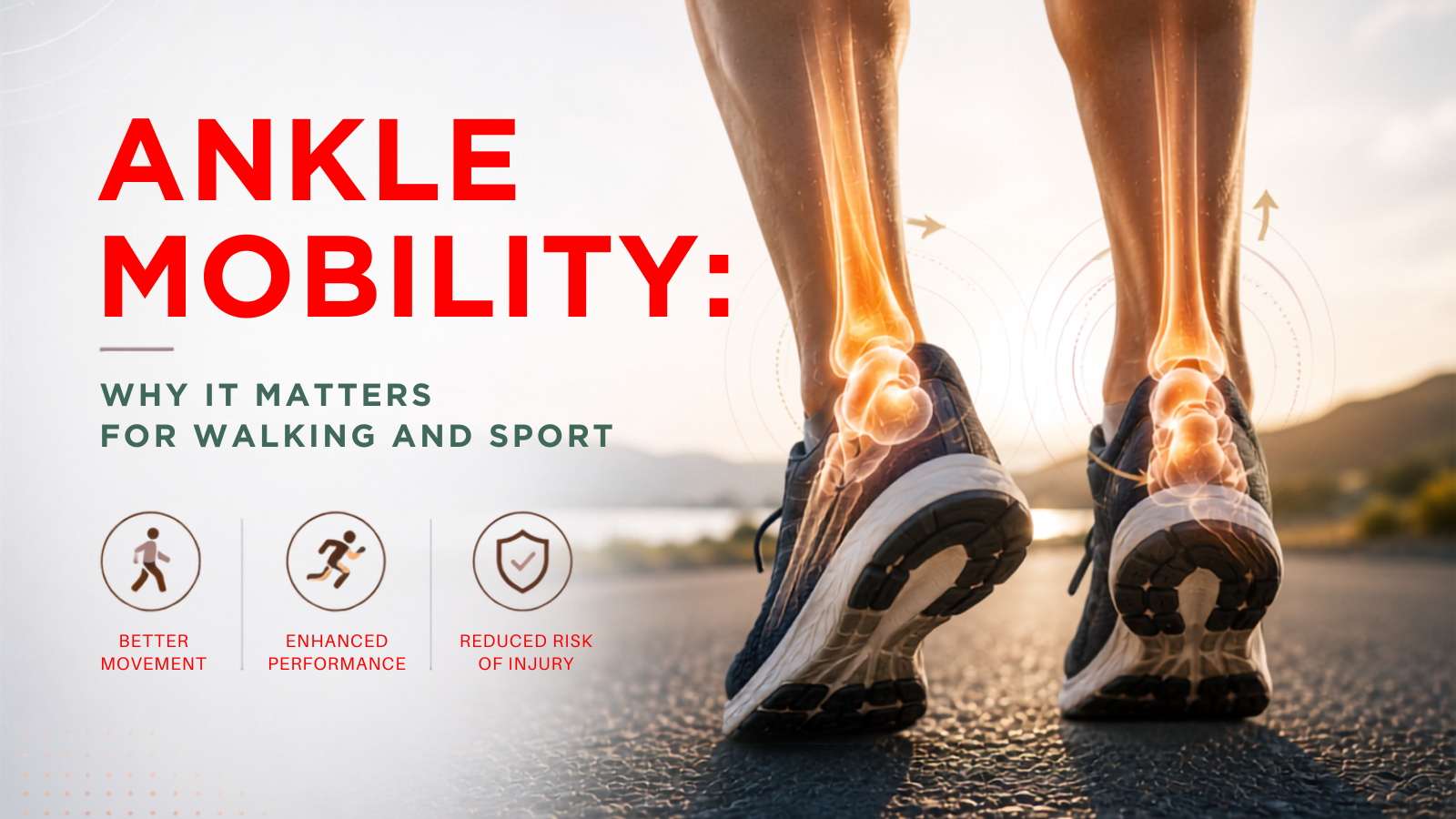
Ankle Mobility: Why It Matters for Walking and Sport

When people think about movement, they often focus on larger joints such as the hips, knees or shoulders. However, the ankles play an equally important role in everyday mobility and athletic performance.
Every step you take, whether walking to work, climbing stairs or playing sport, relies on healthy ankle movement. When ankle mobility becomes restricted, the body may compensate by changing the way it moves, potentially placing extra demands on the knees, hips and lower back.
Understanding why ankle mobility matters can help you support better movement, improve performance and reduce unnecessary strain during daily activities and exercise.
Ankle mobility refers to the ability of the ankle joint to move through its normal range of motion with good control.
Healthy ankle mobility allows the foot and lower leg to work together efficiently during activities such as:
Mobility is different from flexibility.
While flexibility relates to the length of muscles, mobility also includes joint movement, muscle control and stability.
All of these factors contribute to efficient movement.
The ankle is the first major joint to absorb force when the foot contacts the ground.
It also helps:
When ankle movement is restricted, the body often adapts by changing movement elsewhere.
These changes may affect the knees, hips or lower back over time.
Walking appears simple, but it involves a coordinated sequence of movements.
During each step, the ankle needs to move smoothly as the body progresses over the foot.
Restricted ankle mobility may contribute to:
These adaptations may not always cause immediate discomfort, but repeated movement over time can increase physical demands on other areas of the body.
Sport places much greater demands on the ankles than everyday walking.
Athletes regularly perform movements involving:
Each of these actions requires adequate ankle mobility combined with strength and stability.
Restricted movement may reduce efficiency and make certain movements more difficult to perform comfortably.
Yes.
The body functions as a connected kinetic chain.
If ankle movement is restricted, the hips and lower back may adapt to maintain forward movement.
For example:
These compensation patterns vary between individuals, but they highlight the importance of assessing the whole body rather than one joint in isolation.
A comprehensive assessment typically involves more than simply looking at the ankle itself.
Healthcare practitioners may evaluate:
Including:
Observing movement patterns may reveal compensation strategies.
Assessing ankle range of motion provides valuable information about joint function.
Muscle control and stability are essential for healthy ankle movement.
Activities such as squatting, lunging or balancing on one leg may highlight movement limitations.
Chiropractic care may form part of a broader management approach for people experiencing ankle stiffness, movement restrictions or lower limb discomfort.
After an appropriate assessment, care may include:
The goal is often to support mobility, movement quality and physical function while addressing contributing factors identified during assessment.
Ankle mobility supports efficient walking, running, balance and sporting performance while helping distribute forces throughout the lower body.
Restricted ankle mobility may alter movement patterns and increase physical demands on the knees in some individuals.
Common signs include ankle stiffness, difficulty squatting, heel lifting during squats, reduced balance and recurring ankle sprains.
Yes. Limited ankle movement may contribute to compensatory movement patterns involving the hips and lower back.
Following an appropriate assessment, chiropractic care may help support joint mobility, movement quality and musculoskeletal function depending on the individual’s presentation.
Experiencing ankle stiffness, recurring sprains or movement limitations? Book an appointment online with Wellbeing Chiropractic clinics across Melbourne, Sydney and Brisbane for a personalised assessment to help improve your mobility, movement and overall function.
Author
Dr Hayden Ford has a special passion for postural conditions, chronic pain and surgical prevention due to having competed at national level as an athlete and undergoing extensive rehabilitation for his our injuries.
Hayden’s history of chiropractic began over 12 years ago, his body could not handle the stress of his sport, gymnastics. Due to the physical nature of the sport, Hayden suffered 3 shoulder surgeries, 3 shoulder dislocation and a fracture. It was through discipline that Hayden was able to reach heights of a professional gymnast. Hayden reached his highest peak in gymnastics when he competed at national level, international level and in trials for the Commonwealth games.
Select a location to book your $49 May assessment
Select a location to book your $49 May assessment
Select a location to book your $49 May assessment
Select your Victoria clinic to book your $49 new patient visit.
$49 New Patient Assessment ● First Adjustment Included*
*Adjustment included when your chiropractor confirms care is clinically appropriate for you. If chiropractic isn’t the right fit, we’ll tell you that too.
Select your New South Wales clinic to book your $49 new patient visit.
$49 New Patient Assessment ● First Adjustment Included*
*Adjustment included when your chiropractor confirms care is clinically appropriate for you. If chiropractic isn’t the right fit, we’ll tell you that too.
Select your Queensland clinic to book your $49 new patient visit.
$49 New Patient Assessment ● First Adjustment Included*
*Adjustment included when your chiropractor confirms care is clinically appropriate for you. If chiropractic isn’t the right fit, we’ll tell you that too.