
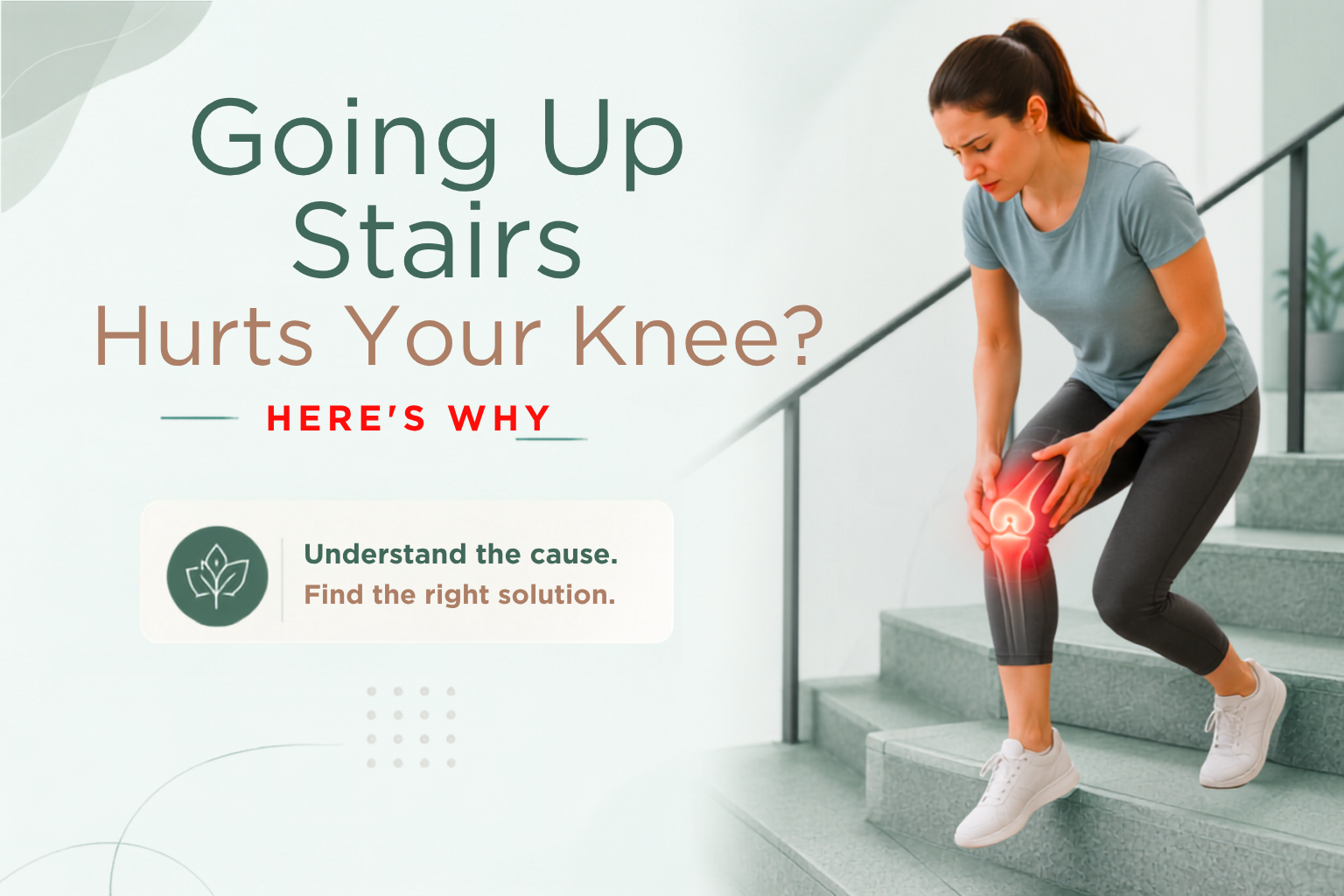
Going Up Stairs Hurts Your Knee? Here’s Why

You can walk around the supermarket without a problem.
You make it through a stroll around the neighbourhood.
But the moment you start climbing a flight of stairs, your knee lets you know something isn’t quite right.
If this sounds familiar, you’re not alone.
Pain when walking upstairs is one of the most common reasons people seek advice for knee problems. The discomfort may be mild at first, only appearing after a long day, or it may become noticeable every time you climb a staircase.
The important thing to understand is that stairs don’t usually create the problem. They often reveal one that’s already there.
Walking on level ground is relatively gentle on your knees.
Climbing stairs is another story.
Every step upwards requires your knee to:
Because the demand is greater, even small changes in the way your knee moves can become much more noticeable.
This is why people often say, “I only feel it on the stairs.”
It seems logical to assume that knee pain must mean there’s something wrong with the knee itself.
However, your knee sits between two very important joints: the hip and the ankle.
If either of these isn’t moving or functioning well, your knee may need to compensate.
For example:
This is one reason a comprehensive assessment looks at the whole lower limb rather than focusing only on the painful area.
The location of your discomfort can provide useful clues.
Some people notice pain:
Each pattern may suggest different contributing factors, which is why describing exactly where you feel pain is an important part of an assessment.
Many people can’t remember one specific injury.
Instead, they notice that climbing stairs has slowly become more uncomfortable over time.
This gradual onset may be related to:
The body often adapts remarkably well until one area begins handling more load than it can comfortably manage.
It’s easy to assume that pain while climbing stairs means something in the knee has been seriously damaged.
Fortunately, that’s often not the case.
Many knee conditions improve with appropriate management, and the amount of pain you feel doesn’t always reflect the extent of tissue changes.
A professional assessment helps identify the likely contributors and guides an appropriate management plan.
The demands on your knees don’t begin and end with the staircase.
Think about everything they do throughout the day.
They help you:
If your muscles are tired or your movement patterns change, you may notice symptoms during stair climbing before any other activity.
A comprehensive assessment considers much more than the knee itself.
Your chiropractor may assess:
This whole-body approach helps identify the factors contributing to your symptoms rather than focusing solely on where the pain is felt.
Following an appropriate assessment, chiropractic care may form part of a broader approach to managing knee pain.
Depending on your presentation, care may include:
Management is individualised according to your symptoms, examination findings and lifestyle.
Climbing stairs places greater demand on the knee than walking on flat ground. Pain may be related to how the knee, hips and ankles work together during movement.
Going upstairs requires your muscles to generate more force to lift your body, increasing the load through the knee joint. This can make underlying movement issues more noticeable.
It depends on the severity of your symptoms. Mild discomfort may settle with appropriate management, but persistent or worsening pain should be professionally assessed.
Reduced strength in the hips, thighs or surrounding muscles may affect how your knee handles load during stair climbing.
Following an appropriate assessment, chiropractic care may help improve joint mobility, movement quality and lower limb biomechanics as part of an individualised management plan.
If knee pain is making stairs, work or exercise more difficult, book an appointment online with Wellbeing Chiropractic. With clinics across Melbourne, Sydney and Brisbane, our experienced chiropractors can assess your movement, identify contributing factors and create a personalised care plan to help you move with greater confidence and comfort.
Author
Dr. Conrad Hor is an experienced and passionate chiropractor with strong clinical knowledge, having worked at clinics in Sydney and Melbourne. Conrad graduated from Macquarie University with a Master’s in Chiropractic and Sydney University with a Bachelor’s of Sport and Exercise Science. Conrad delivers manual chiropractic and lower-force chiropractic care for people of all ages and health backgrounds. He works closely with his patients to ensure they become active participants in their care.
Select a location to book your $49 May assessment
Select a location to book your $49 May assessment
Select a location to book your $49 May assessment
Select your Victoria clinic to book your $49 new patient visit.
$49 New Patient Assessment ● First Adjustment Included*
*Adjustment included when your chiropractor confirms care is clinically appropriate for you. If chiropractic isn’t the right fit, we’ll tell you that too.
Select your New South Wales clinic to book your $49 new patient visit.
$49 New Patient Assessment ● First Adjustment Included*
*Adjustment included when your chiropractor confirms care is clinically appropriate for you. If chiropractic isn’t the right fit, we’ll tell you that too.
Select your Queensland clinic to book your $49 new patient visit.
$49 New Patient Assessment ● First Adjustment Included*
*Adjustment included when your chiropractor confirms care is clinically appropriate for you. If chiropractic isn’t the right fit, we’ll tell you that too.