
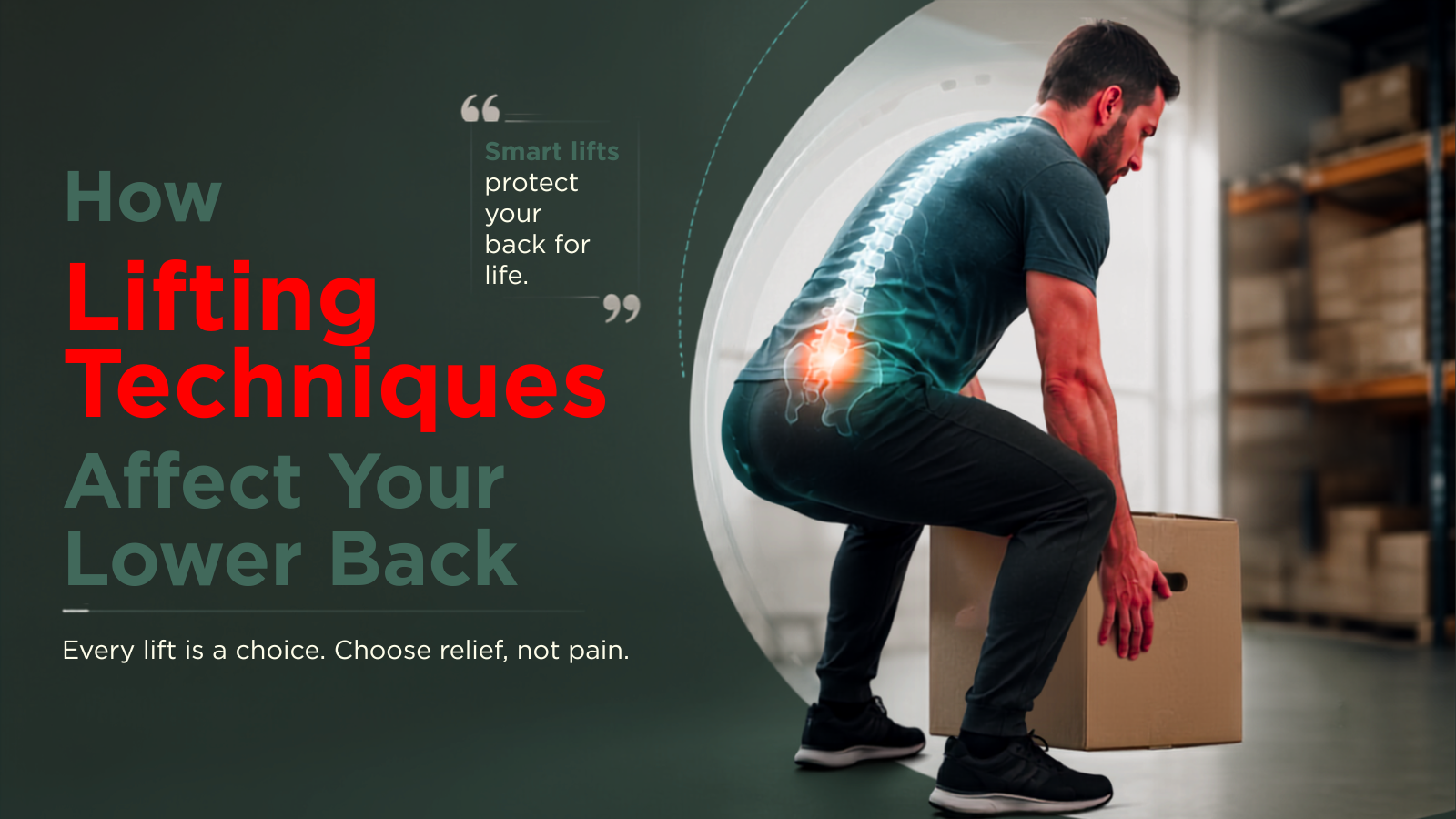
How Lifting Techniques Affect Your Lower Back

Whether you’re lifting a heavy box at work, carrying groceries, moving furniture or picking up a child, the way you lift can place different levels of stress on your lower back. While lifting itself isn’t necessarily harmful, using poor lifting techniques or attempting to lift more than your body is prepared for may increase the likelihood of back pain or injury.
Learning safer lifting habits, maintaining strength and recognising your physical limits can help reduce unnecessary strain on your spine and support long-term back health.
Your lower back, also known as the lumbar spine, plays an important role in supporting your upper body and allowing you to bend, twist and lift. It is made up of vertebrae, intervertebral discs, joints, ligaments and muscles that work together to provide both stability and movement.
When lifting an object, these structures absorb and distribute the forces placed on your body. If the load is too heavy, lifted awkwardly or combined with twisting movements, the tissues in your lower back may be placed under greater stress than they can comfortably tolerate.
Over time, repeated strain may contribute to discomfort or increase the risk of injury.
Many episodes of lower back pain occur during everyday activities rather than dramatic accidents. Some of the most common lifting mistakes include:
Bending forward primarily through your spine instead of your hips and knees can increase stress on the muscles, ligaments and discs in your lower back.
Rotating your body while holding a heavy object places additional forces through the spine. Whenever possible, turn your whole body by moving your feet instead of twisting through your back.
The further an object is from your body, the harder your back muscles need to work. Keeping the load close to your body generally reduces strain.
Trying to lift an object that is heavier than you can comfortably manage increases the likelihood of injury. If in doubt, ask for assistance or use lifting equipment where available.
Rushing a lift without planning your movement can affect your balance and body position, increasing the risk of awkward movements.
Although no single lifting technique completely eliminates the risk of injury, these practical strategies may help reduce unnecessary strain.
Take a moment to assess the weight of the object and decide where you’re moving it. Clear any obstacles from your path before lifting.
Position yourself as close as practical to the load to reduce the distance your back needs to support the weight.
Rather than bending only through your waist, lower yourself by bending your hips and knees while keeping the object close to your body.
Gently engaging your abdominal muscles may help provide additional support during lifting.
Avoid sudden or jerky movements. Lift in a controlled manner and maintain steady breathing throughout the movement.
If you need to change direction, pivot your feet instead of rotating your spine while carrying the load.
Not necessarily.
Even when using good lifting techniques, factors such as fatigue, repetitive lifting, previous injuries, reduced physical conditioning and the weight of the object can still contribute to back pain.
Research suggests that back pain is influenced by multiple factors, including physical demands, general health, sleep quality, stress and overall fitness. This means that lifting technique is just one part of maintaining a healthy back.
If you develop lower back pain after lifting, it’s often helpful to:
If pain is severe, persists for more than a few days, or is accompanied by numbness, weakness or pain travelling down the leg, seek professional assessment.
Some lifting-related back pain may involve the muscles, joints or other structures of the spine. Following a thorough assessment, chiropractic care may be appropriate for certain people with mechanical lower back pain.
Depending on your individual presentation, management may include:
Care is always tailored to the individual and depends on the nature of the injury and examination findings.
Using your hips and knees to help lift, while keeping the object close to your body, generally places less strain on your lower back than bending primarily through your waist.
Poor lifting technique may increase stress on the spine, but disc injuries are usually influenced by multiple factors rather than a single movement.
Not always. Gentle movement is often encouraged, but activities should be guided by your symptoms. If you’re unsure, seek advice from a healthcare professional.
It can contribute in some cases, particularly if lifting is repetitive or symptoms are not properly managed. An assessment can help determine the underlying cause.
If you’ve developed lower back pain after lifting or want advice on reducing the risk of future injuries, book your appointment online with Wellbeing Chiropractic. Our experienced chiropractors provide personalised assessments at our clinics across Melbourne, Sydney and Brisbane to help you move with greater confidence and support your long-term spinal health.
Author
Dr Hayden Ford has a special passion for postural conditions, chronic pain and surgical prevention due to having competed at national level as an athlete and undergoing extensive rehabilitation for his our injuries.
Hayden’s history of chiropractic began over 12 years ago, his body could not handle the stress of his sport, gymnastics. Due to the physical nature of the sport, Hayden suffered 3 shoulder surgeries, 3 shoulder dislocation and a fracture. It was through discipline that Hayden was able to reach heights of a professional gymnast. Hayden reached his highest peak in gymnastics when he competed at national level, international level and in trials for the Commonwealth games.
Select a location to book your $49 May assessment
Select a location to book your $49 May assessment
Select a location to book your $49 May assessment
Select your Victoria clinic to book your $49 new patient visit.
$49 New Patient Assessment ● First Adjustment Included*
*Adjustment included when your chiropractor confirms care is clinically appropriate for you. If chiropractic isn’t the right fit, we’ll tell you that too.
Select your New South Wales clinic to book your $49 new patient visit.
$49 New Patient Assessment ● First Adjustment Included*
*Adjustment included when your chiropractor confirms care is clinically appropriate for you. If chiropractic isn’t the right fit, we’ll tell you that too.
Select your Queensland clinic to book your $49 new patient visit.
$49 New Patient Assessment ● First Adjustment Included*
*Adjustment included when your chiropractor confirms care is clinically appropriate for you. If chiropractic isn’t the right fit, we’ll tell you that too.