
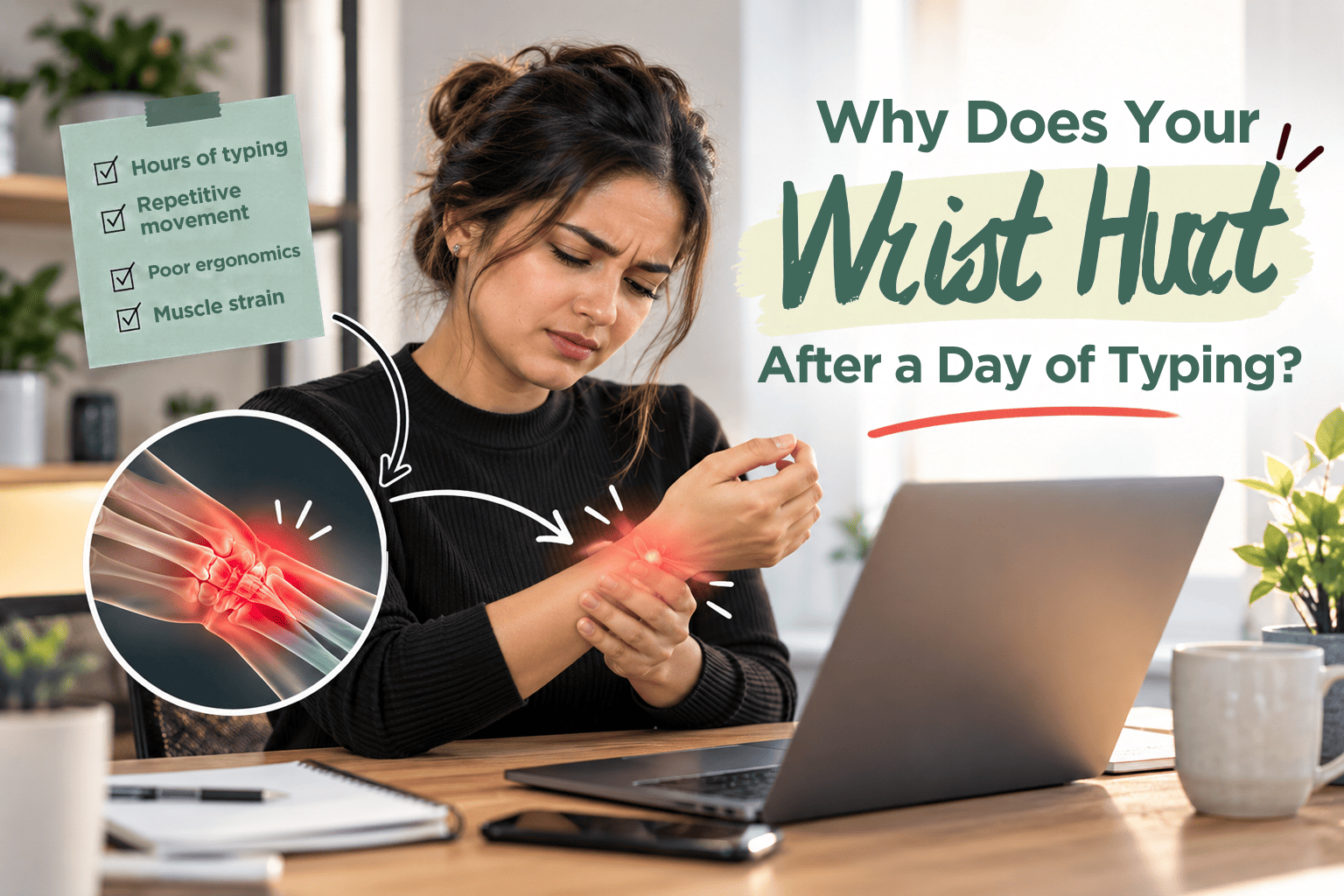
Why Does Your Wrist Hurt After a Day of Typing?
You start work feeling fine.
A few hours of emails, spreadsheets, messages and meetings later, your wrist feels stiff, sore or strangely tired.
By the end of the day, you are shaking your hand out and wondering whether typing can really be responsible.
It can contribute to wrist discomfort, particularly when typing is repetitive and your hands spend long periods doing the same movements.
But typing is rarely the only factor.
Your keyboard and mouse setup, how often you take breaks, the amount of other hand use you do throughout the day, your workload and any existing irritation can all influence how your wrist feels.
Why can typing cause wrist pain?
Typing involves thousands of small movements.
Your fingers repeatedly press keys while your wrists and forearms help stabilise and position your hands.
One keystroke is not a major physical demand.
The issue is repetition.
Think about typing for eight hours.
Even with short breaks, your hands may perform an enormous number of movements over the course of a working day.
Your body can usually tolerate repetitive activity.
Problems can arise when the amount of activity exceeds what your tissues are currently accustomed to, particularly if recovery time is limited.
It may not actually be your keyboard:
This is where things get interesting.
Two people can use the same keyboard for eight hours and have completely different experiences.
Why?
Because the keyboard is only one part of the picture.
Consider everything else you do with your hands.
You might type all morning, use a mouse throughout the afternoon, hold your phone between meetings, drive home, cook dinner and then spend another hour scrolling.
Your wrists and hands do not necessarily get much of a break.
The total amount of repetitive hand and wrist activity may matter more than any single task.
Your mouse could be contributing:
Typing often gets the blame, but mouse use can also place repetitive demands on your hand and wrist.
You may repeatedly:
move the mouse
click
scroll
grip the mouse
reach slightly to one side
keep your hand in the same position
If your mouse is positioned too far away, you may also spend much of the day reaching your arm forwards or out to the side.
This can contribute to fatigue through the hand, wrist, forearm and shoulder.
What does your wrist position look like?
Your wrists do not need to be perfectly straight every second you type.
However, spending long periods with the wrist held in an extreme or uncomfortable position may contribute to symptoms for some people.
For example, you might type with your wrists resting heavily on the desk while your hands angle upwards towards the keyboard.
Or your keyboard may be positioned so far forwards that your wrists remain extended for much of the day.
Small changes to your setup may make typing more comfortable.
Why does your wrist hurt more at the end of the day?
This is a common pattern with repetitive tasks.
Your wrist may feel fine at 9 am.
By 4 pm, it aches.
That does not necessarily mean something suddenly went wrong at 3:55 pm.
The symptoms may reflect the cumulative workload of the day.
It is similar to how your legs can feel tired after standing for hours even though you did not injure them at any particular moment.
Your wrist and forearm may simply be telling you that they have been working repeatedly for a long time.
What if your wrist hurts when you stop typing?
Sometimes discomfort becomes more noticeable once the activity stops.
While you are working, you are focused on the screen and may not pay much attention to mild symptoms.
Once you finish, the stiffness or ache becomes easier to notice.
You might also spend the evening using your phone, gaming or doing household tasks, meaning your hands still are not getting much recovery.
If your wrist remains painful outside work, it is worth looking at your entire day rather than blaming your keyboard alone.
What about numbness or tingling?
An occasional tired wrist is different from symptoms such as persistent numbness, tingling or weakness.
These symptoms can sometimes indicate irritation or compression involving a nerve.
One example is carpal tunnel syndrome, where the median nerve is affected as it passes through the wrist.
Typical symptoms can include numbness, tingling or discomfort affecting parts of the hand, sometimes becoming more noticeable at night.
However, not every case of hand or wrist tingling is carpal tunnel syndrome.
If you are experiencing persistent numbness, tingling or weakness, an appropriate assessment can help determine what may be contributing.
Should you stretch your wrists?
Gentle movement may feel good for some people, particularly if your wrists feel stiff after prolonged computer use.
However, aggressively stretching a painful wrist is not necessarily helpful.
If a stretch increases your pain, numbness or tingling, stop rather than forcing it.
The right exercises depend on what is contributing to your symptoms.
When should wrist pain after typing be assessed?
Consider getting your wrist assessed if:
pain is persistent
symptoms are getting worse
discomfort continues outside working hours
you are losing grip strength
you notice numbness or tingling
your hand feels weak or clumsy
pain is affecting your work
symptoms are waking you at night
the problem started after an injury
Early assessment can be useful when symptoms are becoming a regular part of your working day.
You do not have to wait until you can no longer type comfortably.
Can a chiropractor help with wrist pain?
Depending on the cause of your symptoms, chiropractic care may be appropriate for some types of musculoskeletal wrist, hand and upper-limb pain.
An assessment may consider your wrist and forearm movement, grip, shoulder and neck function, workstation demands, activity levels and any previous injuries.
Management may include hands-on care, exercises, movement advice and practical changes to activities, depending on your individual presentation.
If your symptoms suggest a different type of healthcare assessment is needed, referral may be appropriate.
FAQ
Why does my wrist hurt after typing all day?
Typing involves repetitive hand and wrist movements. A high volume of typing, mouse use, limited breaks and other activities throughout the day can contribute to wrist discomfort for some people.
Can typing cause wrist pain?
Typing can contribute to wrist pain, particularly when combined with prolonged computer use and repetitive activity. However, persistent wrist pain can have several possible causes.
How should I position my wrists when typing?
Aim for a comfortable position that allows your hands to move freely without prolonged extreme bending of the wrists. Your keyboard and chair should be positioned so you are not constantly reaching or holding tension through your shoulders.
Should I stop typing if my wrist hurts?
You may not need to stop completely, but continuing an activity that is consistently increasing pain may not be helpful. Consider reducing or varying the workload, taking regular movement breaks and getting advice if symptoms persist.
Why does my wrist hurt at night after using a computer?
Symptoms can remain noticeable after a day of repetitive hand use. However, wrist pain or tingling that regularly wakes you at night can have other causes and is worth discussing with a healthcare professional.
When should I see someone about wrist pain?
Consider an assessment if wrist pain persists, is worsening, interferes with work or is accompanied by numbness, tingling, weakness or loss of grip strength.
If your wrist regularly hurts after a day of typing, it may be worth looking beyond the keyboard itself. Wellbeing Chiropractic has clinics across Melbourne, Sydney and Brisbane. Book an appointment to discuss your symptoms, movement, workstation demands and daily activities to help you identify what may be contributing.

Author
Dr. Jack Day
I’m Dr Jack Day, chiropractor across our Hoppers Crossing and Werribee clinics, with a Master of Chiropractic from AECC University College in England. That program was built on the idea that treatment without rehabilitation is half a job, and the thinking followed me home: every plan pairs table work with corrective exercise and practical lifestyle advice, because function you build outlasts relief you are given. Sports care is my special interest, from proper athletes to the socially competitive, and the west supplies plenty of both. Then you go beat your own personal bests, which is my favourite part of the whole business.