
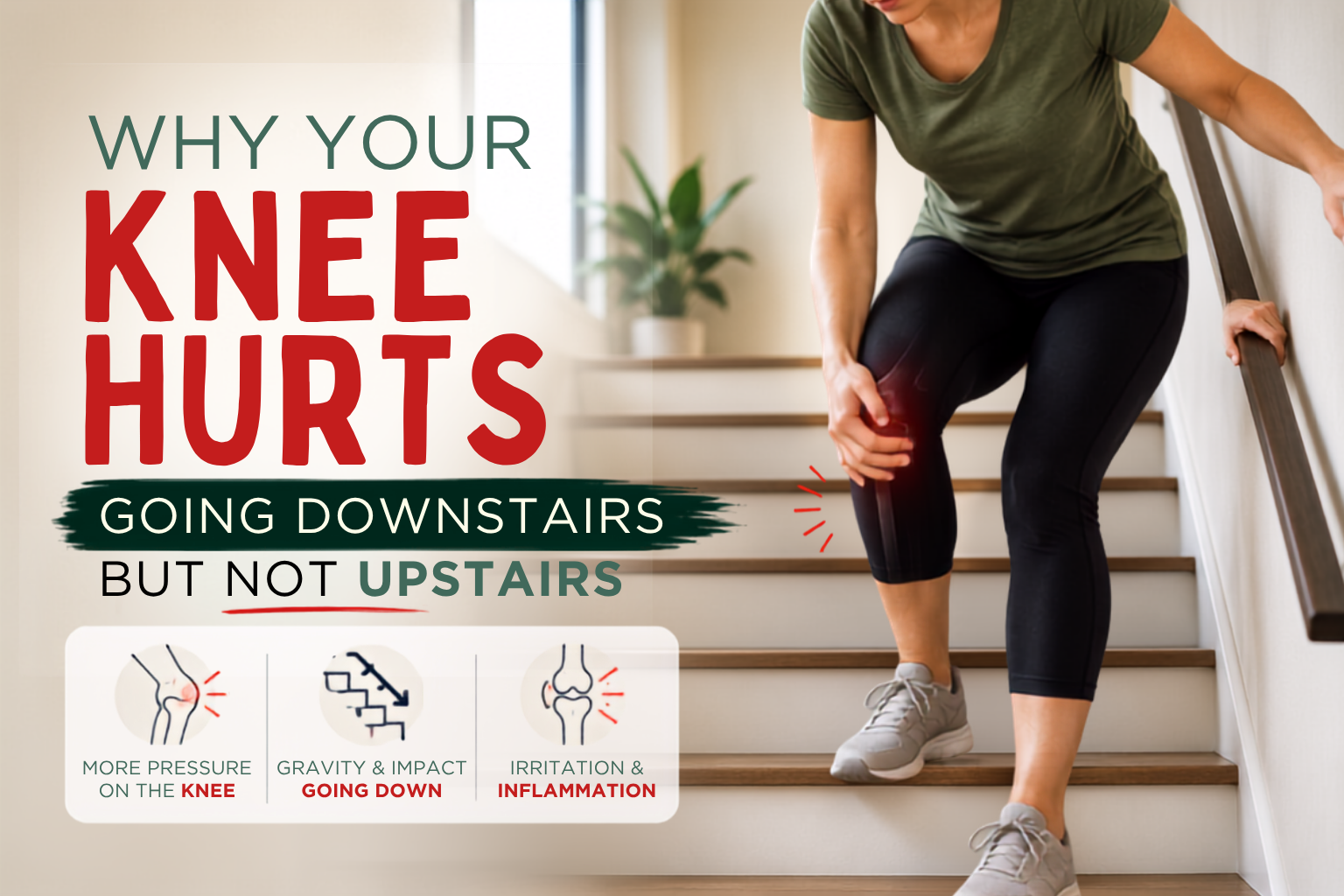
Why Your Knee Hurts Going Downstairs But Not Upstairs

Going up the stairs feels fine.
Then you turn around to come back down and suddenly your knee starts hurting.
It’s a surprisingly common pattern.
You may be able to walk, exercise and climb stairs without much trouble, yet feel pain when lowering yourself down each step.
Why does this happen?
The answer often comes down to how your knee manages load and controls movement when your body is moving downhill.
Knee pain going downstairs can have several possible causes, and the painful knee isn’t necessarily the only area worth assessing.
Walking downstairs isn’t simply the opposite of walking upstairs.
When climbing, your muscles work to push your body upwards.
When descending, your leg muscles need to control your body as gravity pulls you down.
This places different demands on the knee and surrounding muscles.
Your quadriceps, in particular, need to control the bending of your knee as you lower your body onto the next step.
If this movement becomes uncomfortable, you may notice pain on each descent.
Several factors may contribute to this pattern.
These can include:
There isn’t one explanation that applies to everyone.
The kneecap, or patella, moves within a groove at the front of the knee as you bend and straighten your leg.
Activities that involve repeated knee bending can increase the forces around this area.
For some people, discomfort around the front of the knee may become more noticeable during:
This type of discomfort is sometimes associated with patellofemoral pain.
An assessment is needed to determine whether this is relevant to your symptoms.
Going downstairs requires controlled lowering.
If the muscles around your hips and thighs aren’t providing enough strength or control, your knee may move differently during the descent.
This doesn’t mean your muscles are “weak” in a simple sense.
Muscle endurance, coordination and movement control can all influence how your knee handles load.
If you’ve previously injured your knee, your movement may have changed even after the initial pain settled.
You may unconsciously:
Over time, these changes may influence how your knee handles certain activities.
Your injury history is therefore useful information during an assessment.
It may seem strange that the same knee can tolerate going up stairs but not down.
The two movements simply place different demands on the body.
Going up requires your muscles to generate force to lift your body.
Going down requires them to control your descent.
That difference can make symptoms more noticeable in one direction than the other.
Not necessarily.
If your symptoms are mild, completely avoiding stairs may not be required.
However, repeatedly pushing through significant pain isn’t ideal either.
You may temporarily find it more comfortable to:
The right approach depends on the cause and severity of your symptoms.
Consider arranging an assessment if:
Seek prompt medical attention following significant trauma, particularly if you cannot bear weight, the knee is severely swollen or it appears deformed.
Following an appropriate assessment, chiropractic care may form part of a broader approach to managing some types of musculoskeletal knee pain.
Depending on your presentation, care may include:
Your care plan should be based on your symptoms, history and examination findings.
Going downstairs requires your muscles to control your body as you lower it against gravity. Changes in strength, movement control, knee function or surrounding joint mobility may contribute to pain.
Not necessarily. Arthritis is one possible cause, but knee pain can also result from muscle weakness, previous injuries, movement patterns or irritation around the kneecap.
Pain at the front of the knee during activities such as stair descent may be associated with patellofemoral pain, although other conditions can cause similar symptoms.
Not necessarily. Depending on the cause and severity of your symptoms, modifying how you use stairs may be more appropriate than avoiding them completely.
Following an appropriate assessment, chiropractic care may help support knee and lower-limb mobility, movement quality and musculoskeletal function as part of an individualised management plan.
If knee pain is making stairs, exercise or everyday activities uncomfortable, book an appointment online with Wellbeing Chiropractic. With clinics across Melbourne, Sydney and Brisbane, our experienced chiropractors can assess your knee and overall lower-limb movement to identify potential contributing factors and develop a personalised care plan.
Author
Dr. Amanda is available for appointments at our Moorabbin & Epping clinics.
Amanda has special interests in traditional and modern chiropractic care for people of all ages. She graduated from RMIT University with a double degree, Bachelor’s degree in Health Science & Bachelor’s degree in Applied Science (Chiropractic)
Select a location to book your $49 May assessment
Select a location to book your $49 May assessment
Select a location to book your $49 May assessment
Select your Victoria clinic to book your $49 new patient visit.
$49 New Patient Assessment ● First Adjustment Included*
*Adjustment included when your chiropractor confirms care is clinically appropriate for you. If chiropractic isn’t the right fit, we’ll tell you that too.
Select your New South Wales clinic to book your $49 new patient visit.
$49 New Patient Assessment ● First Adjustment Included*
*Adjustment included when your chiropractor confirms care is clinically appropriate for you. If chiropractic isn’t the right fit, we’ll tell you that too.
Select your Queensland clinic to book your $49 new patient visit.
$49 New Patient Assessment ● First Adjustment Included*
*Adjustment included when your chiropractor confirms care is clinically appropriate for you. If chiropractic isn’t the right fit, we’ll tell you that too.