
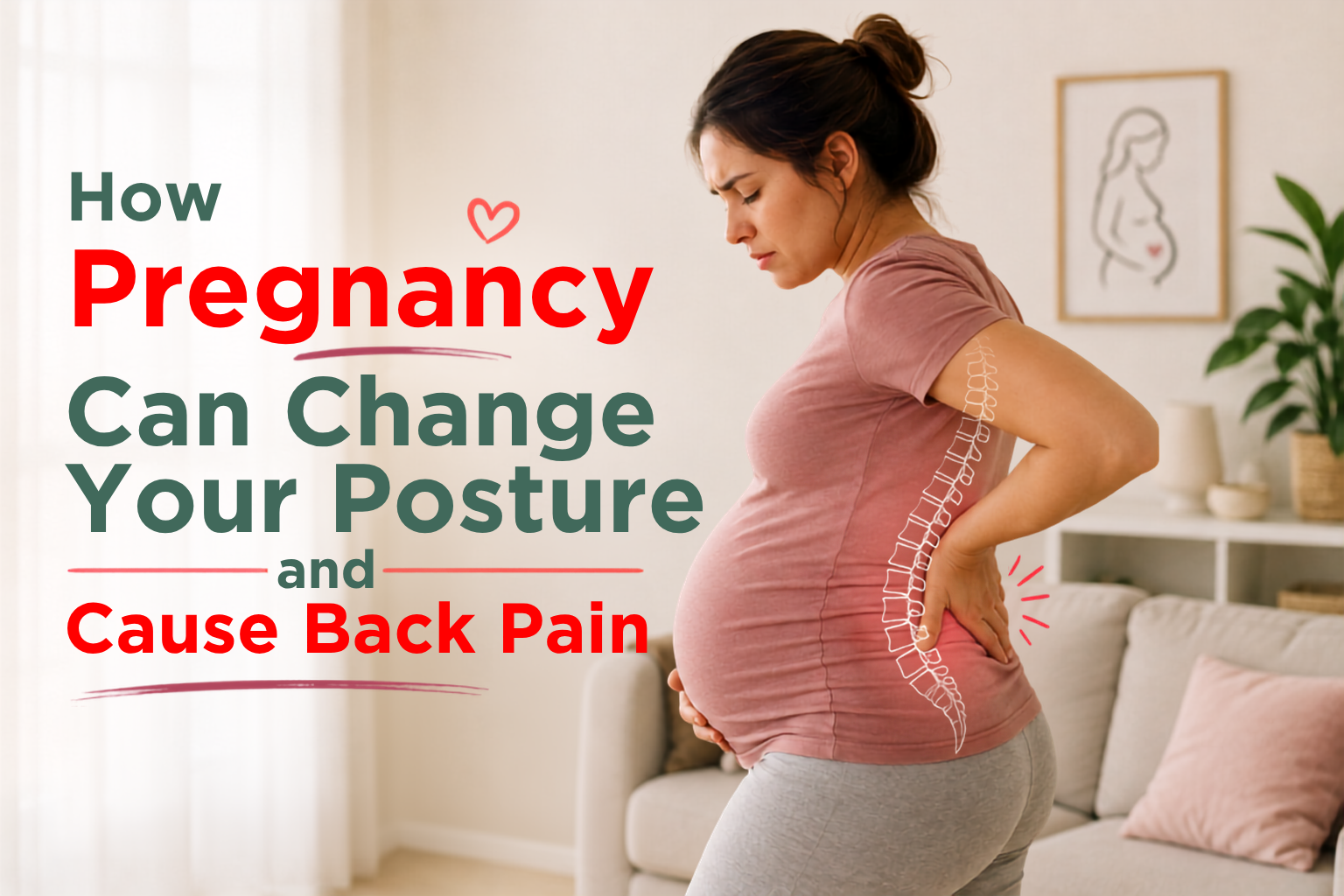
How Pregnancy Can Change Your Posture and Cause Back Pain

Pregnancy brings some remarkable changes to the body.
As your baby grows, your weight distribution changes, your abdomen expands and your centre of gravity gradually shifts. These changes can influence the way you stand, walk, sit and move.
For many women, this can contribute to back or pelvic discomfort during pregnancy.
That doesn’t mean back pain is something you simply have to put up with. Understanding why your posture changes and how your body is adapting can help you make practical adjustments throughout pregnancy.
As pregnancy progresses, the growing abdomen moves your body’s centre of mass forwards.
Without thinking about it, you may adjust your posture to maintain balance.
You might notice:
These adaptations are normal responses to the physical changes taking place.
However, they can also alter how forces are distributed through the muscles and joints around your lower back and pelvis.
Pregnancy isn’t simply about a growing belly.
Your body undergoes a range of changes that can influence movement.
Hormonal changes can affect connective tissues, while changes in body weight and balance alter the physical demands placed on your muscles and joints.
As a result, movements that previously felt effortless may require more effort.
Getting out of bed, climbing stairs or standing for long periods can become noticeably different.
Your lower back helps support your body while you stand, walk and perform everyday activities.
As your centre of gravity changes during pregnancy, the muscles around your lower back, hips and pelvis may work differently to maintain stability.
This may contribute to:
The exact experience varies considerably between individuals.
It’s tempting to blame pregnancy back pain entirely on posture.
But there usually isn’t one single explanation.
Discomfort may be influenced by a combination of:
This is why individual assessment is important.
Getting comfortable at night can become increasingly difficult as pregnancy progresses.
Poor sleep may also leave you feeling more sensitive to aches and stiffness during the day.
Pillows can sometimes be used to support comfortable positioning, such as placing one between the knees or using additional support where needed.
If you’re unsure about the safest or most comfortable sleeping position for your stage of pregnancy, discuss it with your midwife or obstetrician.
Pregnancy doesn’t necessarily mean stopping physical activity.
For many healthy pregnancies, staying appropriately active can support:
Walking, swimming and pregnancy-appropriate strengthening may be suitable for many people.
However, exercise recommendations during pregnancy should be individualised, particularly if you have pregnancy complications or have been advised to restrict activity.
You don’t need to force yourself into a rigid upright position.
Your body is adapting for a reason.
Instead of constantly pulling your shoulders back or trying to flatten your lower back, focus on comfortable movement and changing positions throughout the day.
Pregnancy posture isn’t about looking perfectly aligned. It’s about supporting your body as it changes.
Following an appropriate assessment, chiropractic care may form part of a broader approach to managing musculoskeletal discomfort during pregnancy.
Depending on your symptoms and stage of pregnancy, care may include:
Care should be individualised and provided in coordination with your broader maternity care where appropriate.
Pregnancy can change your centre of gravity, body weight, muscle demands and movement patterns. These changes may contribute to lower back or pelvic discomfort for some women.
Pregnancy temporarily changes the way your body moves and carries weight. Many of these adaptations gradually change again after pregnancy.
For many healthy pregnancies, appropriate physical activity can be beneficial. However, exercise should be guided by your maternity care team if you have complications or specific medical advice.
Following an appropriate assessment, pregnancy-appropriate chiropractic care may help support comfortable movement and manage some musculoskeletal symptoms.
Contact your maternity care provider if pain is severe, unusual or accompanied by symptoms such as bleeding, fever, abdominal pain, contractions, fluid leakage or changes in fetal movement.
If pregnancy-related back or pelvic discomfort is affecting your everyday activities, book an appointment online with Wellbeing Chiropractic. With clinics across Melbourne, Sydney and Brisbane, our experienced chiropractors can provide an individualised assessment and pregnancy-appropriate care based on your symptoms and stage of pregnancy.
Author
Dr. Amanda is available for appointments at our Moorabbin & Epping clinics.
Amanda has special interests in traditional and modern chiropractic care for people of all ages. She graduated from RMIT University with a double degree, Bachelor’s degree in Health Science & Bachelor’s degree in Applied Science (Chiropractic)
Select a location to book your $49 May assessment
Select a location to book your $49 May assessment
Select a location to book your $49 May assessment
Select your Victoria clinic to book your $49 new patient visit.
$49 New Patient Assessment ● First Adjustment Included*
*Adjustment included when your chiropractor confirms care is clinically appropriate for you. If chiropractic isn’t the right fit, we’ll tell you that too.
Select your New South Wales clinic to book your $49 new patient visit.
$49 New Patient Assessment ● First Adjustment Included*
*Adjustment included when your chiropractor confirms care is clinically appropriate for you. If chiropractic isn’t the right fit, we’ll tell you that too.
Select your Queensland clinic to book your $49 new patient visit.
$49 New Patient Assessment ● First Adjustment Included*
*Adjustment included when your chiropractor confirms care is clinically appropriate for you. If chiropractic isn’t the right fit, we’ll tell you that too.