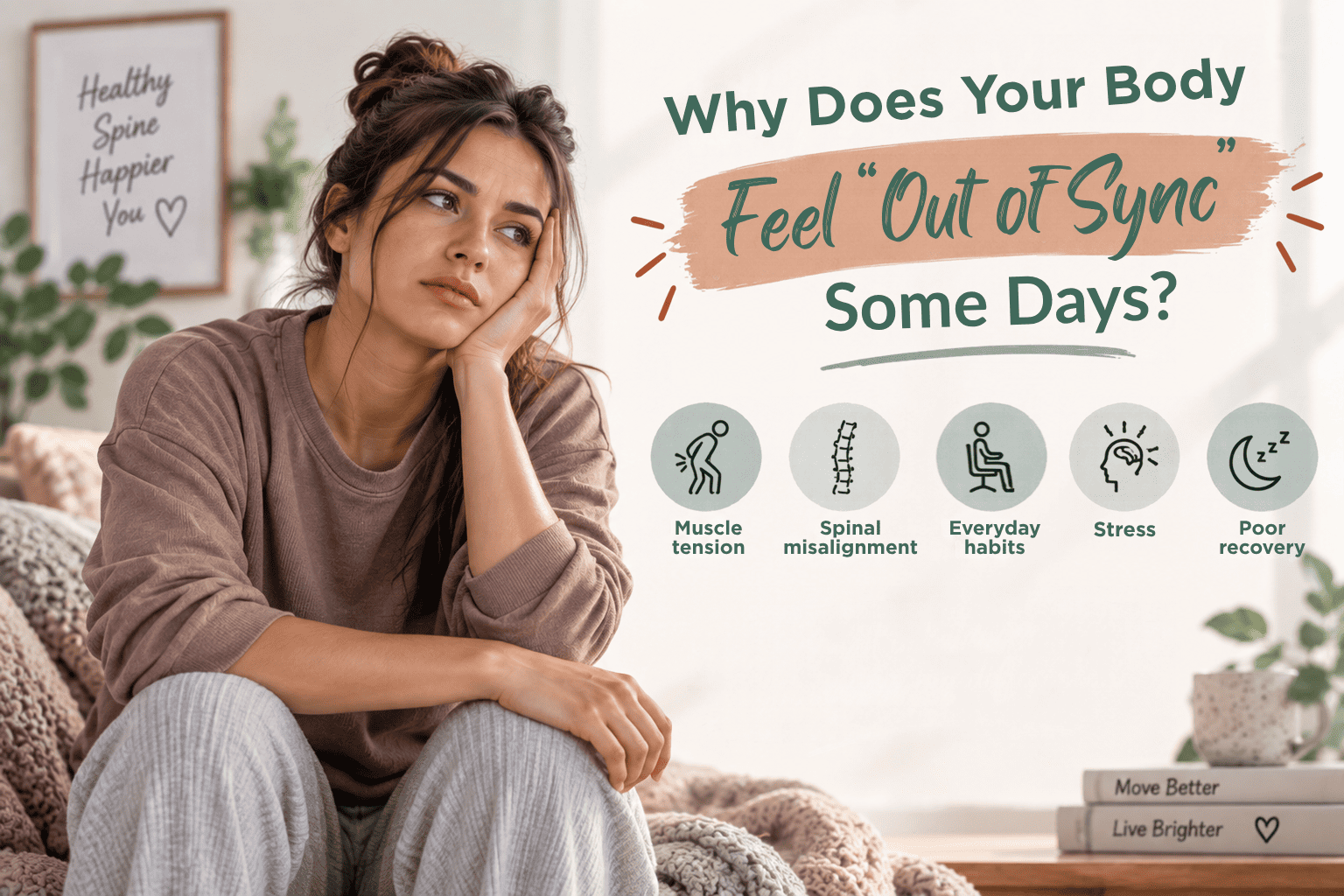
Why Does Your Body Feel “Out of Sync” Some Days?
You wake up and something feels different.
Your back is a little stiffer than usual.
One shoulder feels tight.
Your hips feel heavy when you walk downstairs.
You stretch, but somehow that doesn’t quite fix it.
Nothing hurts badly enough to stop you doing your day. You just don’t feel like you’re moving properly.
It is one of those days where your body feels “out of sync”.
Then, strangely enough, the next morning you feel completely normal again.
So what is going on?
The reality is that how your body feels can change from day to day, even when nothing obvious has gone wrong. Your sleep, activity, stress, workload, exercise, recovery and even how much time you spend sitting can all influence how you move and how noticeable certain aches and stiffness feel.
Your body doesn’t start every day from the same place:
This is probably the simplest way to think about it.
You might do the same job every day, but every day is not physically identical.
One night you sleep brilliantly.
The next night you toss and turn.
One day you walk 10,000 steps.
The next, you’re stuck behind a desk.
One week you train consistently.
The next, work gets hectic and you barely exercise.
Your body responds to the whole picture, not just one activity.
That is why you can perform the same movement on Monday without a problem and find it surprisingly uncomfortable on Thursday.
1. You slept, but perhaps you didn’t recover as well
Eight hours in bed does not necessarily mean eight hours of great recovery.
Maybe the kids woke you up.
Maybe you went to bed later than usual.
Maybe you were stressed and never really switched off.
Maybe you woke several times without remembering it clearly.
Poor or disrupted sleep can influence how your body feels the next day.
You may notice more muscle tension, less energy and greater awareness of aches that you would normally barely notice.
This doesn’t mean the pain is “in your head”
Sleep, stress and pain are closely connected, but that does not make physical symptoms imaginary.
Your nervous system helps regulate how you experience discomfort.
When you are tired or under pressure, familiar aches can sometimes feel more noticeable.
2. Yesterday was more physical than you realised
Think back over the previous day.
Did you:
- carry something heavy?
- spend hours gardening?
- play sport?
- walk much further than normal?
- clean the house from top to bottom?
- spend the afternoon doing DIY?
- return to the gym after a break?
- chase the kids around all weekend?
None of these things needs to cause an injury.
But they can leave your body feeling different the following day.
This is particularly common when you do something your body is not currently accustomed to.
The weekend can catch you out
You sit at a desk all week.
Saturday arrives.
Suddenly you’re mowing the lawn, moving furniture, washing the car and heading out for a long walk.
Sunday morning?
Your back, legs and shoulders have opinions.
That does not necessarily mean you have done something wrong.
Your body may simply be responding to a sudden change in workload.
3. You have been sitting more than usual
Sometimes the opposite happens.
You haven’t done too much.
You have done almost nothing.
A busy week means you spend hours at your desk, then commute home, eat dinner and collapse on the couch.
By Friday, your body feels strangely stiff.
It can be tempting to think, “I haven’t done anything, so why am I sore?”
But your body still responds to how long you spend in one position.
Your body likes variety
You do not need to stand all day.
You do not need perfect posture.
You simply need opportunities to change position.
Stand up.
Walk around.
Stretch gently if it feels good.
Take the longer route to the kitchen.
Move between tasks.
Small amounts of movement spread throughout the day can be easier on the body than spending hours in one position and trying to compensate with one intense workout.
Why does one side sometimes feel completely different?
This is another common experience.
Your right hip feels fine.
Your left hip feels tight.
Your left shoulder feels stiff.
Your right side feels normal.
That does not automatically mean your body is “out of alignment”.
Most people naturally have differences between their left and right sides.
You probably favour one hand, one leg or one side when carrying things.
You may always sleep on the same side.
You may have had an old injury that changed how you move.
Small differences are normal.
What matters more is whether the difference is new, painful, worsening or affecting what you can do.
Why can you feel better after a shower or walk?
You may have noticed this yourself.
You wake up stiff.
You have a shower.
You walk around the house.
You make coffee.
Twenty minutes later, you feel much more normal.
Movement changes how your body feels.
After spending hours asleep, your muscles and joints have had very little movement. Getting up and moving around can make stiffness feel less noticeable for some people.
This is one reason a gentle morning routine can feel better than immediately sitting down for another hour.
Can a chiropractor help when your body feels out of sync?
If your symptoms appear to be musculoskeletal, a chiropractor may be able to help assess what is contributing to the way you are feeling.
An assessment may consider your symptoms, movement, strength, previous injuries, work, exercise, sleep and everyday activities.
The goal is not necessarily to find one body part that is “out of alignment”.
It is to understand the pattern and identify factors that may be contributing to your symptoms.
Depending on your individual presentation, management may include hands-on care, exercises, movement advice or changes to activities.
If your symptoms suggest another type of healthcare assessment is more appropriate, referral may be recommended.
FAQ
Why does my body feel different from one day to the next?
Your body responds to changes in sleep, activity, stress, workload, exercise and recovery. These factors can influence muscle tension, stiffness and how strongly you notice discomfort.
Why do I feel stiff even when I haven’t exercised?
Stiffness can occur after spending long periods sitting or staying in one position. Poor sleep, stress and changes in your usual activity can also influence how your body feels.
Why does one side of my body feel tighter?
Some asymmetry is completely normal. You may favour one side during work, sport or everyday activities. New, painful or worsening differences may warrant an assessment.
Should I stretch when my body feels stiff?
Gentle stretching may feel helpful for some people, but it is not always the answer. If an area repeatedly feels tight, consider the activities and positions that may be contributing rather than simply stretching harder.
Is feeling “out of sync” a sign something is wrong?
Not necessarily. Occasional stiffness or changes in how your body feels are common. Persistent, worsening or function-limiting symptoms are more useful reasons to seek an assessment.
When should I see someone about feeling stiff or out of sync?
Consider an assessment if symptoms keep returning, are getting worse, limit your movement or interfere with work, exercise or sleep. Sudden weakness, significant neurological symptoms or severe symptoms following trauma require prompt medical attention.
If your body keeps having those days where nothing feels quite right, an individual assessment may help you understand the pattern. Wellbeing Chiropractic with clinics across Melbourne, Sydney and Brisbane. Book an appointment to discuss your symptoms, movement and everyday activities and explore options based on your individual history and examination findings.

Author
Dr. Jack Day
I’m Dr Jack Day, chiropractor across our Hoppers Crossing and Werribee clinics, with a Master of Chiropractic from AECC University College in England. That program was built on the idea that treatment without rehabilitation is half a job, and the thinking followed me home: every plan pairs table work with corrective exercise and practical lifestyle advice, because function you build outlasts relief you are given. Sports care is my special interest, from proper athletes to the socially competitive, and the west supplies plenty of both. Then you go beat your own personal bests, which is my favourite part of the whole business.