
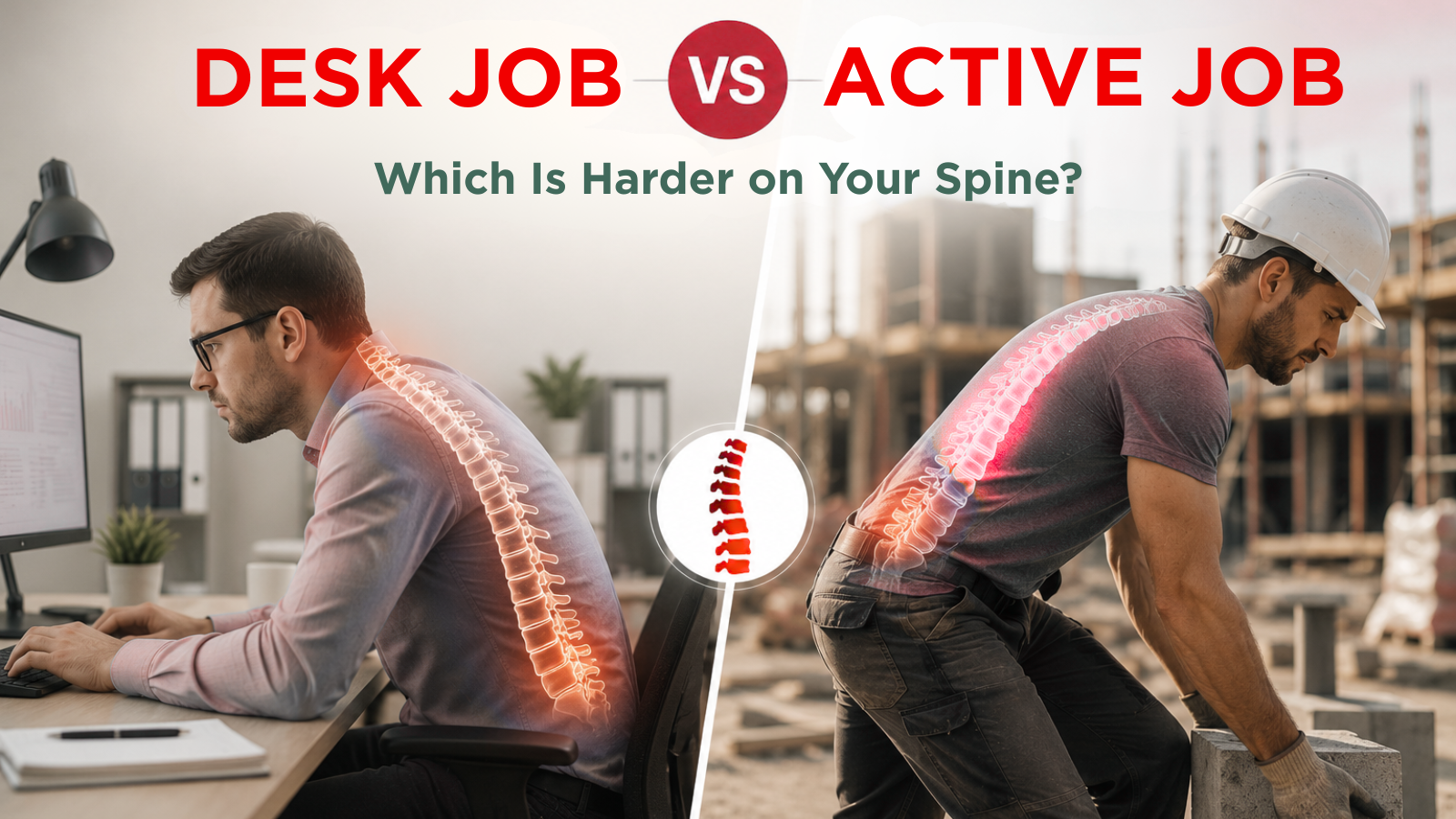
Desk Job vs Active Job: Which Is Harder on Your Spine?

When it comes to spinal health, many people assume physically demanding jobs place the greatest strain on the body. Others believe sitting at a desk all day is the bigger problem.
The reality is that both desk jobs and active jobs can place significant stress on the spine, but often in different ways.
Whether you spend your day in front of a computer, on a construction site, driving long distances or working in healthcare, the demands of your job can influence how your back, neck and joints feel over time.
Understanding the unique challenges of different work environments can help you better manage discomfort and support long-term spinal health.
A common misconception is that physically active jobs are automatically harder on the spine than office-based work.
In reality, both environments create specific physical demands.
A desk worker may spend eight hours sitting in relatively static positions, while a tradesperson may spend the day lifting, bending and carrying loads.
Both situations can contribute to musculoskeletal strain, but the contributing factors are often very different.
The key issue is not necessarily whether a job is active or sedentary. It is how the body responds to the demands placed upon it day after day.
Modern office work often involves prolonged sitting, computer use and repetitive tasks.
While sitting itself is not inherently harmful, remaining in the same position for extended periods may contribute to physical discomfort for some individuals.
Common challenges associated with desk work include:
Over time, these factors may contribute to:
Many office workers report feeling relatively comfortable during work hours but notice stiffness and discomfort later in the day.
The human body is designed to move regularly.
Remaining in one position for long periods may lead to:
Even people who sit with excellent posture may experience discomfort if they rarely change position throughout the day.
This is why regular movement breaks are often encouraged in office environments.
Active occupations create a different set of physical demands.
Examples include:
These jobs often involve:
Over time, these demands may contribute to fatigue, muscle tension and increased strain on various parts of the spine.
Research and clinical experience suggest that both sedentary and physically active workers commonly experience musculoskeletal discomfort.
The location and nature of symptoms often differ.
Rather than one job type being worse than the other, each presents its own challenges.
One of the most important factors for spinal health is movement variety.
The spine generally tolerates movement well. Problems can sometimes arise when the body experiences either:
Changing positions regularly throughout the day may help reduce physical strain.
For desk workers, this may involve standing, walking or stretching periodically.
For active workers, it may involve varying tasks, managing workload and incorporating recovery strategies.
Chiropractic care may form part of a broader approach to managing work-related musculoskeletal discomfort.
After an appropriate assessment, care may include:
The aim is often to support mobility, movement quality and physical function while addressing factors that may be contributing to discomfort.
Care recommendations are typically tailored to the individual’s work environment, symptoms and goals.
Desk jobs may contribute to neck, shoulder and back discomfort when prolonged sitting, poor ergonomics and limited movement are involved. Regular movement and workstation adjustments may help reduce strain.
Not necessarily. Prolonged standing can also place stress on muscles and joints. Variety in movement and position changes throughout the day are often beneficial.
Both active and sedentary jobs can contribute to back pain, but the causes may differ. Active jobs often involve physical strain, while office jobs commonly involve prolonged sitting and static postures.
Regular exercise may support strength, mobility and recovery. However, workplace habits and physical demands may still need to be addressed.
After an appropriate assessment, chiropractic care may help support mobility, movement quality and musculoskeletal function depending on the individual’s presentation and workplace demands.
Whether you work behind a desk or in a physically demanding role, recurring back or neck discomfort should not be ignored. Book an appointment online with Wellbeing Chiropractic clinics across Melbourne, Sydney and Brisbane for an individual assessment tailored to your work demands and lifestyle.Author
Dr. Conrad Hor is an experienced and passionate chiropractor with strong clinical knowledge, having worked at clinics in Sydney and Melbourne. Conrad graduated from Macquarie University with a Master’s in Chiropractic and Sydney University with a Bachelor’s of Sport and Exercise Science. Conrad delivers manual chiropractic and lower-force chiropractic care for people of all ages and health backgrounds. He works closely with his patients to ensure they become active participants in their care.
Select a location to book your $49 May assessment
Select a location to book your $49 May assessment
Select a location to book your $49 May assessment
Select your Victoria clinic to book your $49 new patient visit.
$49 New Patient Assessment ● First Adjustment Included*
*Adjustment included when your chiropractor confirms care is clinically appropriate for you. If chiropractic isn’t the right fit, we’ll tell you that too.
Select your New South Wales clinic to book your $49 new patient visit.
$49 New Patient Assessment ● First Adjustment Included*
*Adjustment included when your chiropractor confirms care is clinically appropriate for you. If chiropractic isn’t the right fit, we’ll tell you that too.
Select your Queensland clinic to book your $49 new patient visit.
$49 New Patient Assessment ● First Adjustment Included*
*Adjustment included when your chiropractor confirms care is clinically appropriate for you. If chiropractic isn’t the right fit, we’ll tell you that too.