
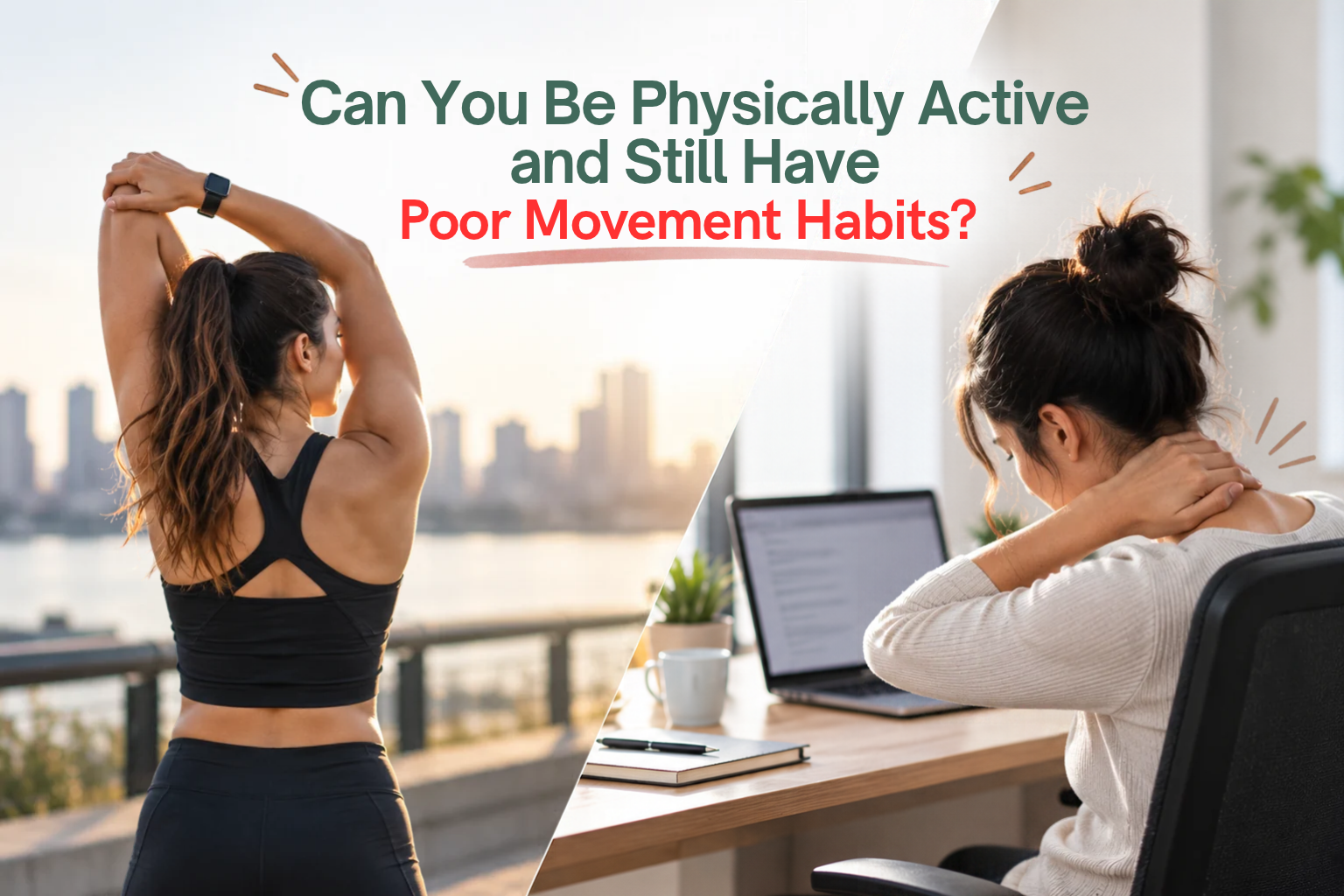
Can You Be Physically Active and Still Have Poor Movement Habits?
You might go to the gym four times a week, play weekend sport, walk regularly or even run several kilometres before work.
You consider yourself an active person.
But you also spend eight hours sitting at a desk, drive everywhere, rarely take movement breaks and spend most evenings in the same position on the couch.
Despite your exercise routine, you regularly experience neck stiffness, lower back discomfort or tight hips.
How can you be physically active and still have poor movement habits?
Being physically active does not automatically mean you move regularly or vary your positions throughout the day. Your exercise routine is only one part of your overall movement habits.
You can be fit and strong while still spending long periods in positions or repeating movements that contribute to discomfort.
Understanding the difference between exercise and everyday movement can help you make more balanced choices for your body.
Exercise and everyday movement are not the same thing:
Exercise is planned physical activity designed to improve or maintain fitness, strength, endurance or another physical ability.
Everyday movement includes the smaller activities you perform throughout the day.
These might include:
walking around your workplace
standing while taking a phone call
bending to pick something up
climbing stairs
changing position while sitting
carrying shopping bags
moving around the house
Both matter, but they serve different purposes.
For example, someone might complete a demanding 45-minute gym session before work and then spend the remaining nine hours sitting at a computer.
They are exercising regularly, but their overall day may still involve very little movement variety.
A workout does not automatically cancel out an entire day of prolonged sitting or repetitive positioning.
Why does movement variety matter?
Your body is designed to perform different types of movement.
Your joints allow movement in different directions, while muscles work together to produce and control those movements.
When your daily routine becomes highly repetitive, certain muscles and joints may experience more frequent demands than others.
For example:
Desk workers may spend much of the day sitting with their hips bent.
Tradies may repeatedly lift, carry, kneel or reach overhead.
Drivers may spend extended periods in relatively fixed positions.
Runners may perform thousands of similar lower-limb movements each week.
Parents may regularly carry children on the same side.
None of these activities is automatically a problem.
The issue may arise when the same demands are repeated without enough variation, recovery or preparation for the workload.
Movement variety allows you to expose your body to different physical demands rather than relying on the same patterns all day.
Can poor movement habits cause back and neck pain?
They can contribute to discomfort in some circumstances, but there is rarely one simple explanation for musculoskeletal pain.
Back and neck symptoms can be influenced by several factors, including:
physical workload
previous injuries
strength and mobility
sleep quality
stress
training volume
prolonged or repetitive activities
individual health conditions
For example, someone who exercises regularly but spends most of their workday looking at a laptop may notice neck and shoulder discomfort.
Another person may experience lower back stiffness after combining a physically demanding job with long periods of driving.
It is important not to assume that a particular posture or movement habit is automatically damaging.
Instead, look at how your symptoms relate to your activities and whether changing your routine makes a difference.
What does a balanced movement routine look like?
There is no perfect daily routine that everyone needs to follow.
However, a balanced approach generally includes a combination of:
| Movement type | Everyday examples |
|---|---|
| Cardiovascular activity | Walking, cycling, swimming or running |
| Strength | Resistance training, bodyweight exercises |
| Mobility | Comfortable joint movement and flexibility exercises |
| Balance and coordination | Single-leg exercises, balance activities, sport |
| General movement | Walking between tasks, stairs and household activities |
| Recovery | Sleep, lighter activity and appropriate rest |
Australian physical activity guidelines provide a useful starting point for adults. Generally, adults are encouraged to accumulate 150 to 300 minutes of moderate-intensity physical activity, or 75 to 150 minutes of vigorous-intensity activity, each week, alongside muscle-strengthening activities on at least two days.
These are population-level recommendations, not a requirement to follow one particular exercise programme. Your health, abilities and circumstances should guide what is appropriate.
When should you get movement-related discomfort assessed?
Being active does not mean you should ignore persistent pain.
If you regularly experience discomfort during everyday activities, it may be worth investigating what is contributing.
Consider an assessment if:
neck or back stiffness keeps returning
certain movements are becoming increasingly difficult
pain is affecting your exercise routine
discomfort is interfering with work or sleep
you are avoiding activities you previously enjoyed
you experience persistent joint pain or reduced movement
Seek prompt medical advice for significant injuries, unexplained weakness, persistent numbness or other concerning symptoms.
An appropriate healthcare professional can consider your symptoms, medical history, movement and physical demands to determine what further assessment or management may be suitable.
How can a chiropractor assess your movement habits?
A chiropractic assessment may consider more than the area where you experience discomfort.
Depending on your presentation, it may involve discussing your work routine, exercise habits, previous injuries and the activities that make your symptoms better or worse.
Your chiropractor may also assess relevant spinal and joint movement, strength and other physical findings.
This can help build a broader understanding of your musculoskeletal health.
If appropriate, recommendations may include movement modifications, exercise advice or other conservative management options. Where symptoms suggest a different medical issue, referral to another healthcare professional may be necessary.
The aim should be to provide advice that considers your individual circumstances rather than assuming that everyone needs the same exercises or treatment.
FAQ
Can you exercise regularly and still be sedentary?
Yes. Someone can complete regular workouts but still spend most of the remaining day sitting. Exercise is important, but reducing prolonged sedentary time and incorporating general movement are also worthwhile.
Does going to the gym fix poor posture?
Not automatically. Strength training can support physical capacity, but posture and movement habits are influenced by many factors. A varied exercise routine and regular movement throughout the day may be more useful than focusing on one ideal posture.
How much should I move during the day if I already exercise?
There is no universal number of movement breaks that suits everyone. A practical starting point is to avoid unnecessarily long periods in one position and look for opportunities to move regularly throughout your day.
Can poor movement habits cause back pain?
Certain repetitive activities and prolonged positions may contribute to discomfort in some people. However, back pain is multifactorial and cannot usually be attributed to one movement habit alone.
Is walking enough to maintain good movement habits?
Walking is an excellent form of physical activity, but it does not address every aspect of physical fitness. Depending on your needs, strength, balance and mobility activities may also be useful.
Should I stretch every day if I feel stiff?
Not necessarily. Stretching may be helpful for some people, but stiffness can have several contributing factors. Comfortable movement, strength, activity changes and appropriate assessment may be more useful depending on the cause.
If you exercise regularly but still experience recurring stiffness, discomfort or difficulty with everyday movements, it may be worth looking beyond your workout routine. Wellbeing Chiropractic has clinics across Melbourne, Sydney and Brisbane. You can book an appointment to discuss your symptoms, movement habits and physical goals and explore options based on your individual assessment.

Author
Dr. Jake Cremona
I’m Dr Jake Cremona, practice partner at Wellbeing Chiropractic and chiropractor at our Austral clinic, and I studied movement before I studied spines: an exercise science degree at the Australian College of Physical Education, then the Master of Chiropractic at Macquarie. The order shapes everything, exercise science taught me how bodies build capacity, chiropractic taught me how to find and treat what blocks it. At Austral I practise Diversified and Gonstead adjusting with a sports thread through the caseload, as an ACA member. Find the underlying cause, explain it so it makes sense, then build a plan that keeps you moving, that is the whole recipe.