
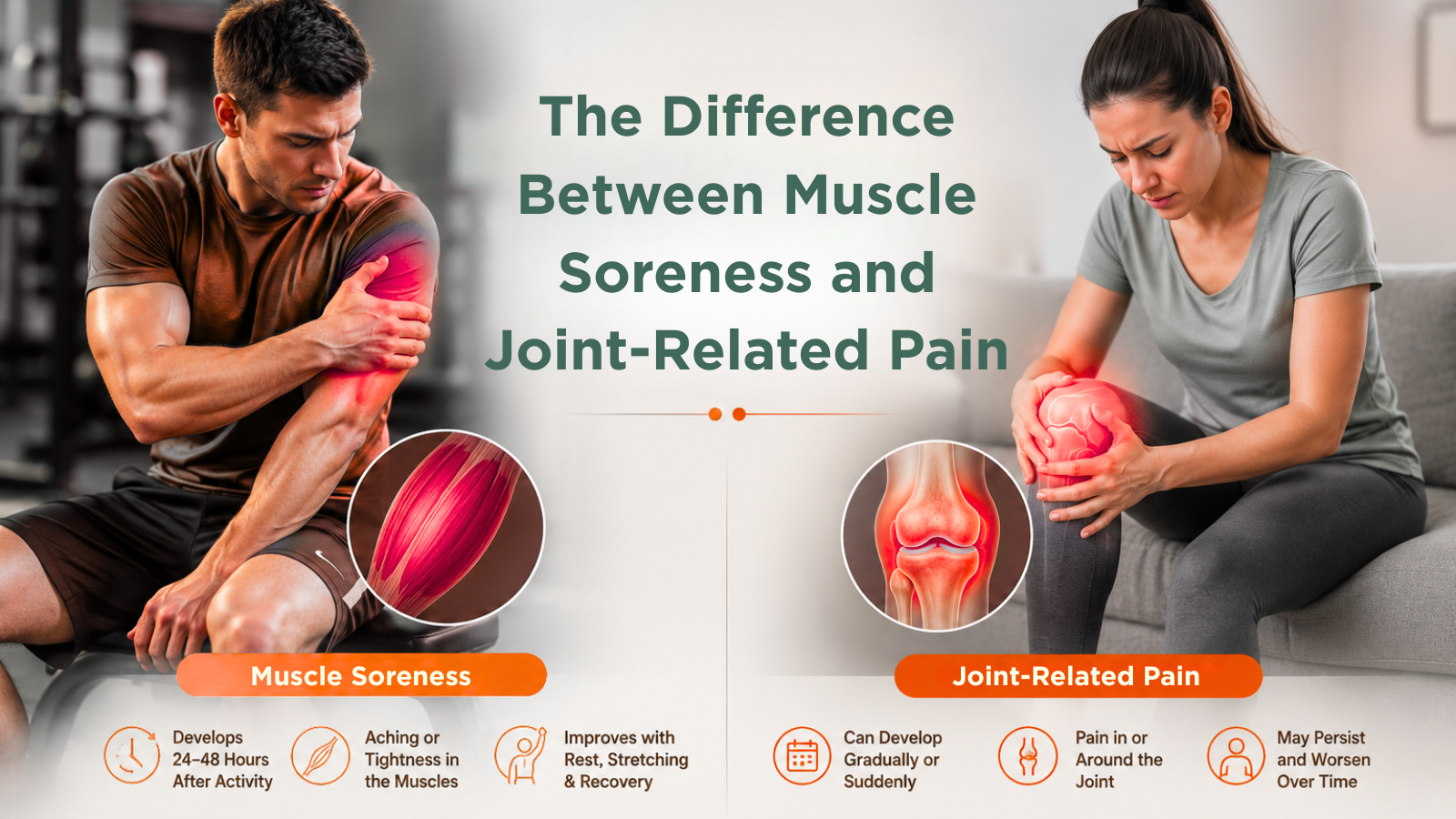
The Difference Between Muscle Soreness and Joint-Related Pain

Many people experience aches and pains throughout daily life, especially after exercise, long hours sitting at a desk, gardening, lifting, or sport. But it is not always easy to tell whether discomfort is coming from the muscles or the joints.
Understanding the difference between muscle soreness and joint-related pain can help you make better decisions about recovery, movement, and when to seek professional advice. While both can cause discomfort and stiffness, they often feel different and may respond differently to care.
In many cases, muscle soreness improves naturally over a few days, while joint-related pain may persist, feel more localised, or affect how a joint moves.
Muscle soreness is typically linked to physical activity, overuse, or unfamiliar movement. It commonly develops after exercise or activities that place extra demand on the muscles.
One of the most common forms is delayed onset muscle soreness (DOMS), which usually appears 12 to 48 hours after activity.
People often describe muscle soreness as:
For example, after a gym session, hike, or weekend sport, you may notice soreness in the thighs, calves, shoulders, or back muscles.
Muscle soreness may occur due to:
In many situations, sore muscles improve gradually with rest, gentle movement, hydration, and recovery strategies.
Joint-related pain is often different from muscle soreness. Rather than feeling spread through the muscle tissue, it may feel more specific to a joint such as the knee, shoulder, neck, hip, ankle, or lower back.
People commonly describe joint-related discomfort as:
Some people also notice swelling, instability, or difficulty putting weight through the area.
Unlike general muscle soreness after exercise, joint-related pain may continue even with rest or return repeatedly during certain movements.
Muscle soreness tends to feel broader and spread across the muscle tissue.
Joint-related pain is often more localised around a specific joint.
Muscle soreness commonly appears after physical activity and improves over several days.
Joint-related pain may come on suddenly, gradually worsen over time, or persist regardless of activity levels.
Muscle soreness is often described as aching, tight, or tender.
Joint-related pain may feel sharper, deeper, or more restricted during movement.
With muscle soreness, movement can feel stiff at first but may improve once the body warms up.
With joint-related pain, certain movements may remain uncomfortable or limited.
Yes. Muscles and joints work closely together, so tension or weakness in one area can influence another.
For example:
This does not necessarily mean there is structural damage. However, movement patterns, posture, workload, and physical demands can all contribute to discomfort.
A proper assessment can help determine whether symptoms are more likely related to muscles, joints, or a combination of both.
Chiropractors commonly assess both muscular tension and joint function. In some cases, joint stiffness may contribute to altered movement patterns, while muscular tightness may place additional strain on surrounding areas.
After an appropriate assessment, chiropractic care may help support:
Care is individual and depends on the nature of the condition, overall health, and personal goals.
For general muscle soreness after activity, people may find the following helpful:
Light walking and gentle mobility work can help reduce stiffness.
Sleep, hydration, and balanced nutrition all support recovery.
Gradually increasing activity levels may reduce excessive soreness.
Some people find temporary relief using heat or cold therapy depending on the situation.
Persistent or worsening pain should not be ignored.
Yes. Mild muscle soreness after exercise is common, especially after new or intense activity. This is often temporary and improves over several days.
Joint-related pain is often more localised and may involve stiffness, clicking, reduced movement, or discomfort during specific motions.
Sometimes. Muscles and joints work together, so symptoms can overlap. A professional assessment may help determine the source of discomfort.
Gentle movement is often tolerated well with mild muscle soreness. However, severe or sharp pain should be assessed before continuing intense activity.
Chiropractors may assess movement, posture, muscular tension, and joint function to better understand contributing factors to pain or stiffness.
Muscle soreness and joint-related pain may seem similar at first, but they often behave very differently. Understanding the difference can help you make smarter decisions about recovery, movement, and when to seek help.Muscle soreness is commonly temporary and activity-related, while joint pain may be more persistent, localised, or mechanically driven.
At Wellbeing Chiropractic, care focuses on identifying the root cause of discomfort and supporting long-term movement, posture, and spinal health across Melbourne, Sydney, and Brisbane. Book an appointment to know the exact issue.
Author
Dr. Conrad Hor is an experienced and passionate chiropractor with strong clinical knowledge, having worked at clinics in Sydney and Melbourne. Conrad graduated from Macquarie University with a Master’s in Chiropractic and Sydney University with a Bachelor’s of Sport and Exercise Science. Conrad delivers manual chiropractic and lower-force chiropractic care for people of all ages and health backgrounds. He works closely with his patients to ensure they become active participants in their care.
Select a location to book your $49 May assessment
Select a location to book your $49 May assessment
Select a location to book your $49 May assessment
Select your Victoria clinic to book your $49 new patient visit.
$49 New Patient Assessment ● First Adjustment Included*
*Adjustment included when your chiropractor confirms care is clinically appropriate for you. If chiropractic isn’t the right fit, we’ll tell you that too.
Select your New South Wales clinic to book your $49 new patient visit.
$49 New Patient Assessment ● First Adjustment Included*
*Adjustment included when your chiropractor confirms care is clinically appropriate for you. If chiropractic isn’t the right fit, we’ll tell you that too.
Select your Queensland clinic to book your $49 new patient visit.
$49 New Patient Assessment ● First Adjustment Included*
*Adjustment included when your chiropractor confirms care is clinically appropriate for you. If chiropractic isn’t the right fit, we’ll tell you that too.