Full Body Biomechanics: How One Area Can Influence Another

When people experience pain, they often focus on the area where symptoms are felt. If the knee hurts, the knee becomes the focus. If there is neck pain, attention naturally shifts to the neck.
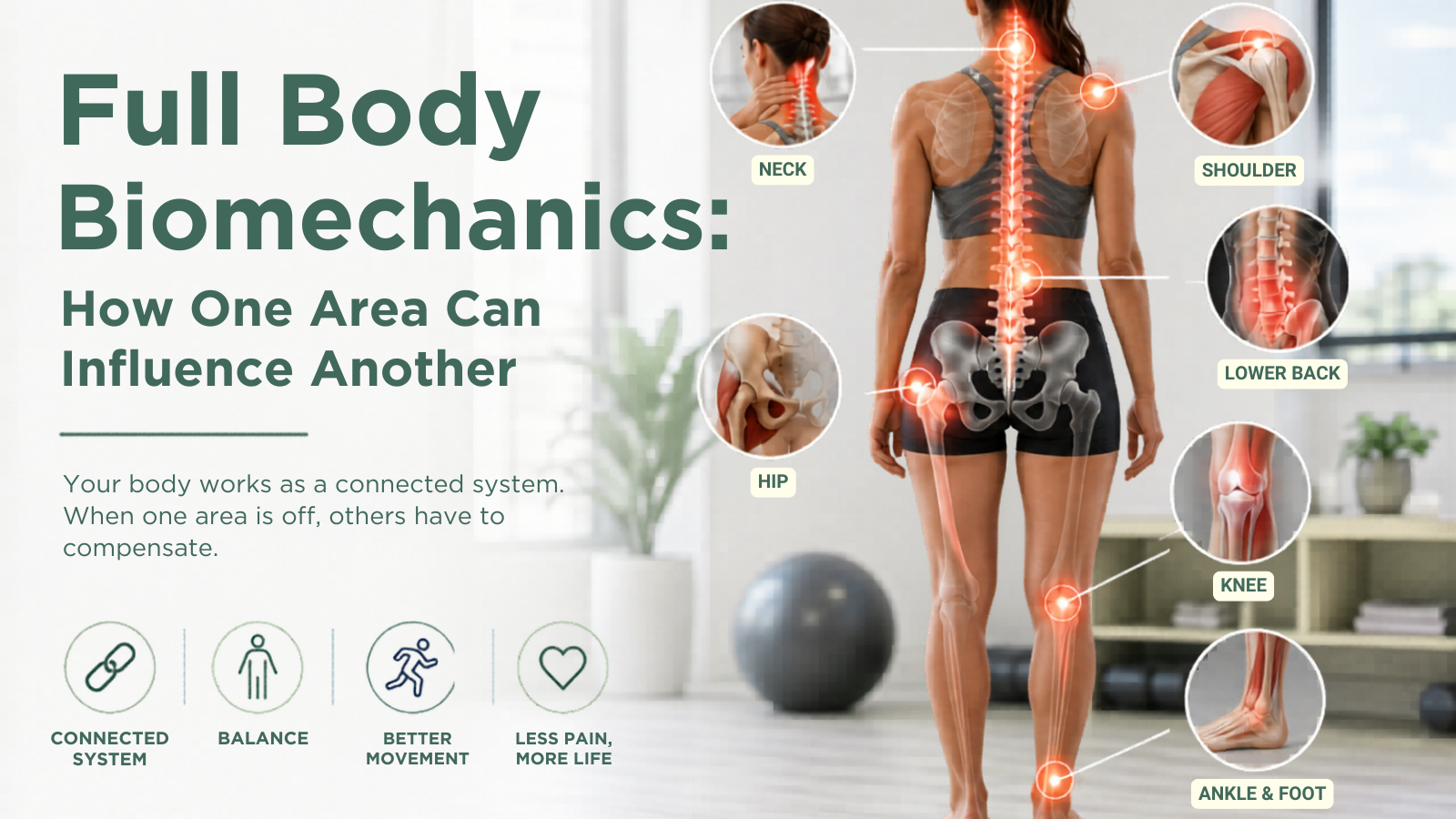
However, the human body does not function as a collection of isolated parts. Every movement relies on a coordinated system of muscles, joints, nerves and connective tissues working together.
This interconnected relationship is often referred to as biomechanics. Understanding full body biomechanics can help explain why pain, stiffness or movement restrictions in one area may influence completely different parts of the body.
For healthcare professionals, looking beyond the site of symptoms is often an important part of understanding how the body moves and functions as a whole.
Biomechanics refers to how the body moves and how forces are distributed through muscles, joints and tissues during everyday activities.
Every action, including walking, bending, lifting, reaching and running, requires multiple body regions to work together efficiently.
Healthy biomechanics typically involves:
When one part of the body is not functioning optimally, movement patterns may change to compensate.
Over time, these compensations can influence other areas of the body.
The hips and lower back frequently work together.
Activities such as:
all require coordinated movement between these regions.
When hip mobility becomes limited, the lower back may compensate by moving more than intended.
This increased demand may contribute to:
This is one reason practitioners often assess hip function when managing lower back complaints.
Many people with neck or shoulder discomfort focus solely on the painful area.
However, the upper back plays an important role in supporting posture and movement.
Reduced mobility through the thoracic spine may affect:
For example, prolonged desk work often contributes to upper back stiffness, which may increase demands on surrounding muscles.
As a result, symptoms may appear in the neck, shoulders or upper back simultaneously.
Some people notice pain moves around the body over time.
A person may begin with lower back discomfort and later develop hip tightness or knee soreness.
This can occur for several reasons, including:
Because the body functions as a connected system, symptoms do not always remain isolated to one location.
Biomechanics is not only about mobility.
Strength and stability are equally important.
Muscles help:
Weakness or poor muscle control in one area may influence how forces are distributed elsewhere.
For example:
This is why many rehabilitation programs focus on strengthening surrounding areas rather than only addressing the painful region.
Movement patterns are shaped not only by anatomy but also by lifestyle.
Factors that may influence biomechanics include:
Extended sitting may affect hip mobility, spinal movement and muscle activation.
Repetition can contribute to muscular fatigue and altered movement strategies.
Both inactivity and sudden increases in activity may influence movement quality.
Sleep, stress management and recovery can affect how the body adapts to physical demands.
Chiropractic care may form part of a broader approach to supporting musculoskeletal health and movement function.
After an appropriate assessment, care may include:
The aim is often to support movement quality, mobility and physical function while addressing factors identified during assessment.
Management plans are tailored to the individual and their specific goals.
Full body biomechanics refers to how muscles, joints and tissues work together to create movement and distribute forces throughout the body.
Yes. Compensation patterns and movement dysfunction may sometimes contribute to symptoms in regions other than the original area of concern.
The kinetic chain describes how different body segments work together during movement. Changes in one area may influence movement elsewhere.
Because movement is interconnected, examining surrounding joints, muscles and movement patterns may help identify contributing factors.
After an appropriate assessment, chiropractic care may help support mobility, movement quality and musculoskeletal function depending on the individual’s presentation and goals.
Experiencing recurring pain, stiffness or movement limitations? Book an appointment online with Wellbeing Chiropractic clinics across Melbourne, Sydney and Brisbane for a comprehensive assessment that looks at how your whole body moves, not just where the pain is felt.Author
Dr. Amanda is available for appointments at our Moorabbin & Epping clinics.
Amanda has special interests in traditional and modern chiropractic care for people of all ages. She graduated from RMIT University with a double degree, Bachelor’s degree in Health Science & Bachelor’s degree in Applied Science (Chiropractic)
Select a location to book your $49 May assessment
Select a location to book your $49 May assessment
Select a location to book your $49 May assessment
Select your Victoria clinic to book your $49 new patient visit.
$49 New Patient Assessment ● First Adjustment Included*
*Adjustment included when your chiropractor confirms care is clinically appropriate for you. If chiropractic isn’t the right fit, we’ll tell you that too.
Select your New South Wales clinic to book your $49 new patient visit.
$49 New Patient Assessment ● First Adjustment Included*
*Adjustment included when your chiropractor confirms care is clinically appropriate for you. If chiropractic isn’t the right fit, we’ll tell you that too.
Select your Queensland clinic to book your $49 new patient visit.
$49 New Patient Assessment ● First Adjustment Included*
*Adjustment included when your chiropractor confirms care is clinically appropriate for you. If chiropractic isn’t the right fit, we’ll tell you that too.