
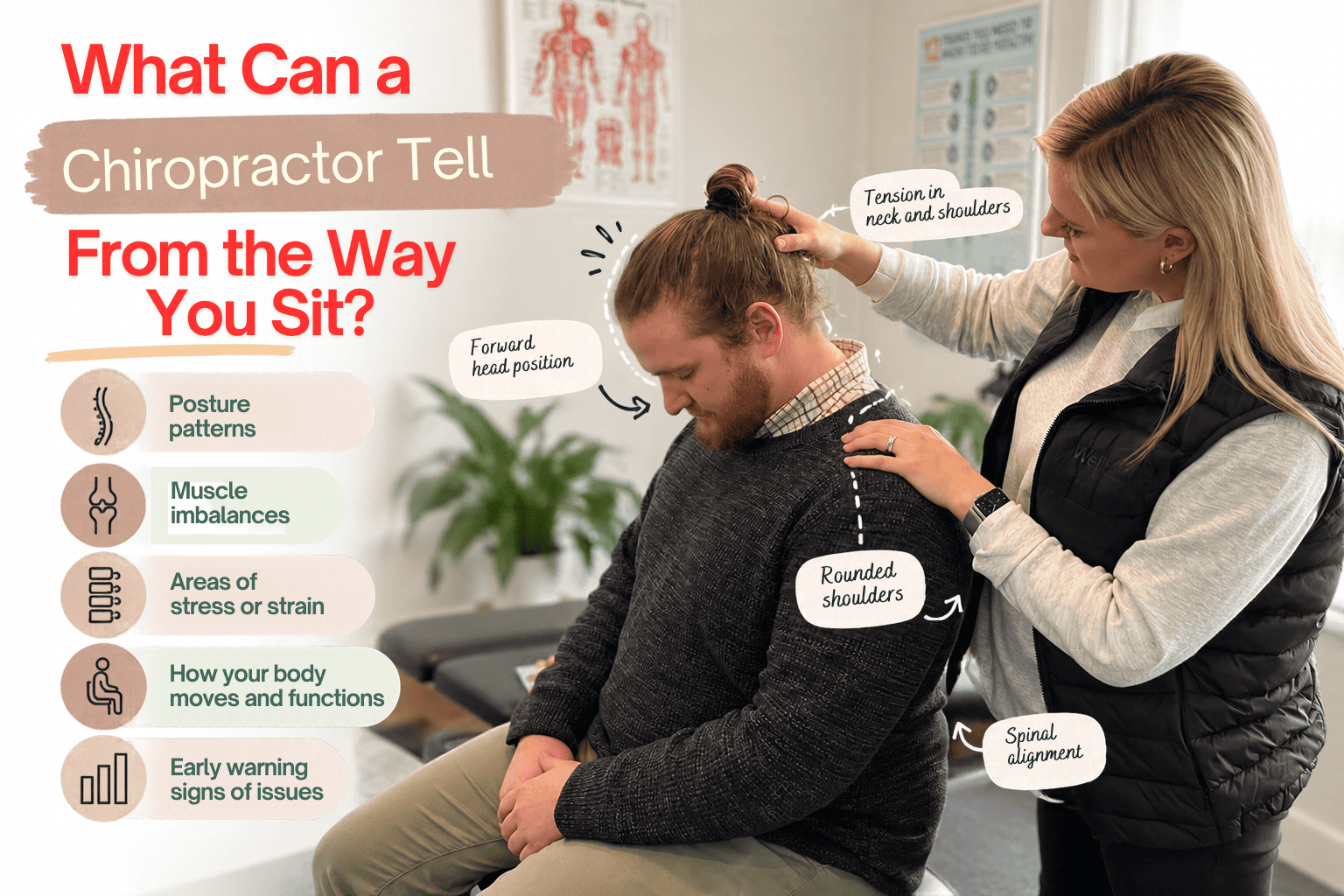
What Can a Chiropractor Tell From the Way You Sit?
You sit down in the consultation room.
Maybe you cross one leg over the other.
Perhaps you lean towards one armrest.
You might sit forward on the edge of the chair or sink comfortably into the backrest.
A chiropractor may notice these things, but they are not necessarily looking for a single “bad posture” that explains all your pain.
The way you sit can provide clues about how you move, what positions feel comfortable and which habits you repeat throughout the day.
It is one small part of a broader assessment.
Your sitting position alone cannot tell a chiropractor exactly what is causing your symptoms.
Instead, it can help start a conversation about your work, daily routines, movement and the situations that make you feel better or worse.
Your sitting position is not a diagnosis:
It is easy to assume that sitting in a certain way must mean something is wrong.
Maybe one shoulder sits higher.
Perhaps you always lean to one side.
Your feet might be tucked underneath your chair.
But people naturally sit in different ways.
There is no single position that every person needs to maintain all day.
A posture that looks unusual does not automatically cause pain, and a posture that looks “perfect” does not guarantee that you will be comfortable.
This is why a chiropractor should consider your symptoms and movement rather than judging your body based on appearance alone.
So what might they actually notice?
You favour one side:
You may consistently put more weight through one hip or lean towards one side.
That could simply be a habit.
It might also be because that position feels more comfortable.
Or perhaps you have an old injury that has influenced how you sit.
The important question is not necessarily, “Why aren’t you sitting evenly?”
It is:
“Why does this position feel natural or comfortable for you?”
That can provide useful information.
You change position frequently:
Constantly shifting in your chair is not automatically a bad thing.
In fact, movement can be useful.
If you regularly change positions because sitting in one position becomes uncomfortable, that may tell your chiropractor something about your tolerance for sustained sitting.
They may ask how long you can sit before symptoms begin and whether standing or walking makes a difference.
You sit very still:
The opposite can also be interesting.
Some people stay in almost exactly the same position for hours.
This is common during desk work, studying, gaming or long periods of driving.
Again, sitting still is not automatically harmful.
But if you are experiencing back or neck discomfort, the amount of time you spend in one position may be relevant.
What does your sitting position say about your daily routine?
Your sitting posture can sometimes provide clues about what you do for hours every day.
For example, an office worker might spend most of the day:
leaning towards a second monitor
reaching for a mouse
looking down at a laptop
sitting through back-to-back meetings
rarely standing between tasks
A driver may spend hours with one leg positioned for the pedals and their upper body facing forwards.
Someone working from home might alternate between a desk, couch and dining table.
These environments create very different movement demands.
A chiropractor may ask about your actual day rather than simply telling you to “sit up straight”.
What if you always cross the same leg?
Most people have a preferred way of sitting.
You may automatically cross your right leg over your left every time you sit down.
That does not necessarily mean you are causing a problem.
But if you are experiencing one-sided hip, back or leg discomfort, it may be worth discussing.
Small habits become more relevant when they are repeated for hours every day.
You do not necessarily need to stop crossing your legs.
Simply becoming aware of how often you stay in one position can be useful.
Can sitting reveal why your back hurts?
It can provide clues, but it cannot provide the whole answer.
Back pain can have many contributing factors.
Your sitting habits may be relevant, particularly if symptoms reliably appear after prolonged sitting.
But your sleep, activity levels, work demands, exercise, previous injuries, stress and general health can also matter.
A good assessment looks at the bigger picture.
What about neck and shoulder pain?
The way you sit can also provide clues when you have neck or shoulder discomfort.
A chiropractor may notice that you regularly:
lean towards one side
sit with your head turned towards a screen
bring your shoulders forwards while typing
hold your phone between your shoulder and ear
look down at a device for extended periods
None of these positions is automatically responsible for pain.
The bigger issue can be the combination of position, duration, repetition and individual tolerance.
A position that feels fine for ten minutes may become uncomfortable after several hours.
When should sitting-related pain be assessed?
Consider an assessment if sitting consistently causes:
hip pain
leg pain
numbness or tingling
increasing stiffness
symptoms that interfere with work or daily activities
You should also consider assessment if symptoms are becoming more frequent or are no longer settling when you change position or move around.
Sudden significant weakness, loss of bladder or bowel control, numbness around the groin or inner thighs, or severe symptoms following significant trauma require urgent medical attention.
Can a chiropractor help with sitting-related pain?
Depending on the cause of your symptoms, chiropractic care may be one option for managing some types of musculoskeletal pain associated with prolonged sitting.
A chiropractor can assess your history, symptoms, movement and daily demands to determine whether chiropractic care may be appropriate.
Recommendations may include hands-on care, exercises, movement strategies or changes to your daily activities, depending on your individual presentation.
If your symptoms suggest another type of healthcare assessment is needed, referral may be recommended.
FAQ
Can a chiropractor tell if my posture is causing my pain?
Posture can be one factor associated with musculoskeletal symptoms, but it is rarely possible to identify the cause of pain from posture alone. A broader assessment of your history, symptoms and movement is more useful.
Is there a correct way to sit?
There is no single sitting position that everyone needs to maintain all day. Changing position regularly and being able to move comfortably are generally more useful goals than trying to hold one posture perfectly.
Is slouching bad for your back?
Slouching is not automatically harmful. However, remaining in any position for a long period can become uncomfortable for some people. Your individual symptoms and tolerance are more important than labelling one position as universally bad.
Why does my back hurt after sitting for a long time?
Prolonged sitting can be uncomfortable for some people, particularly when combined with limited movement, work demands or an existing musculoskeletal problem. The reason varies between individuals.
Should I sit up straight all day?
You do not need to hold yourself rigidly upright all day. Changing position, standing and moving regularly can be more practical than trying to maintain one ideal posture continuously.
When should I see a chiropractor about sitting-related pain?
Consider an assessment if sitting consistently causes pain, stiffness, numbness, tingling or other symptoms that interfere with work or everyday activities. An assessment can help determine whether chiropractic care is appropriate for your situation.
If sitting regularly leaves you uncomfortable, the answer may be more than simply “sit up straight”. Wellbeing Chiropractic has clinics across Melbourne, Sydney and Brisbane. Book an appointment to discuss your symptoms and have your movement, daily habits and physical demands assessed based on your individual history and examination findings.

Author
Dr. Raj Sandhu
I’m Dr Rajan Sandhu, an AHPRA registered chiropractor at our Tarneit and Truganina clinics, consulting in English or Punjabi. I know your side of this chair: a long stretch of debilitating back pain and the painkillers that came with it are what led me into the profession, through training at the AECC in the United Kingdom and years at Europe’s largest chiropractic clinic, where the caseload sharpens you fast. Diversified care, sports rehabilitation and injury management became my staples there and remain them here. Your first visit starts with the full story and a thorough examination, and you will walk out knowing what I found and the plan for it.